

Patricia Simpson (she/her)
Vegetation Technician, Great Basin Institute@Cabrillo National Monument
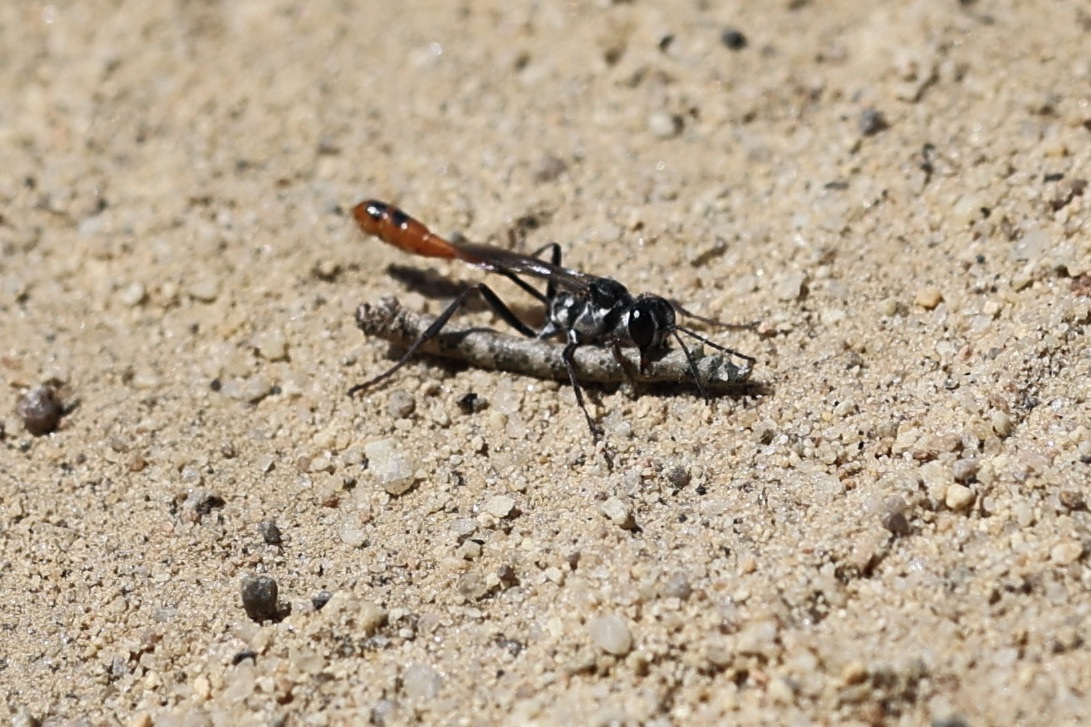
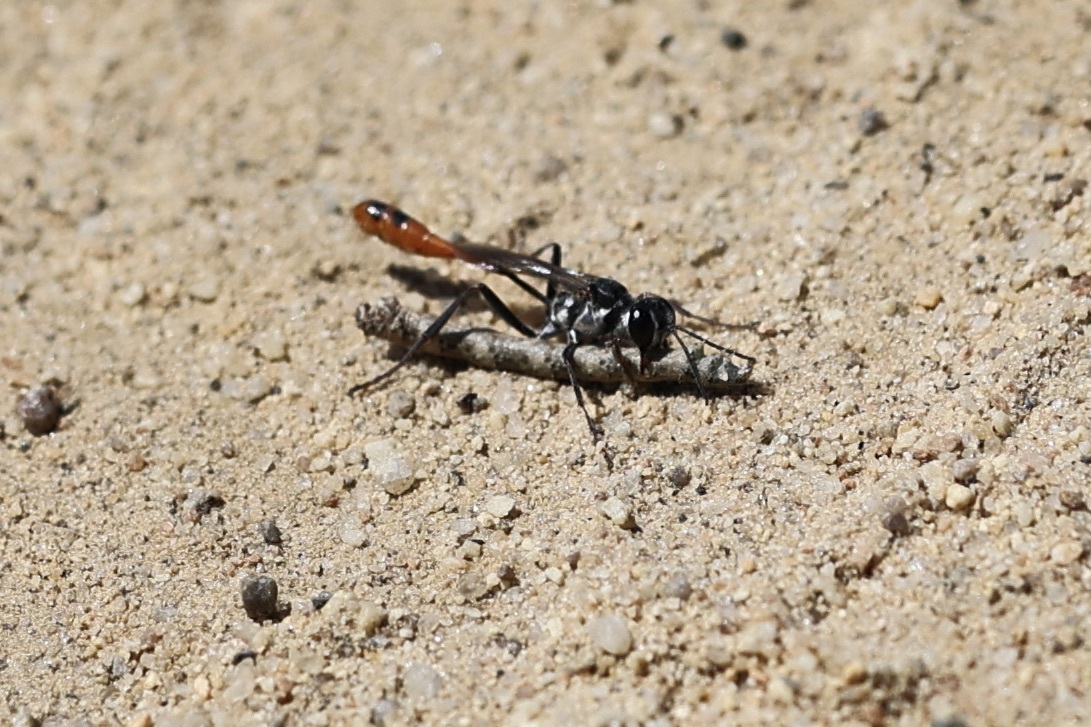
Move over Barbie, there is another thin-waisted beauty in town and she is stunning! Meet the Thread-waisted Sand Wasp (genus Ammophila), a fairly common solitary wasp who hunts caterpillars!
They are many species of Ammophila wasps in North America: over 60. Species, however, are very difficult to tell apart from one another, requiring microscopic studies or even dissection. This means that on iNaturalist, most observations of these wasps will stay at the genus level.
While many of these wasps may be found nesting in the same area, they are solitary. This means a female tends her own nest(s) and does not share her burrow(s). She digs a fairly shallow hole for a single offspring. Then the hunting begins. She seeks caterpillars, stings them to paralyze them, then drags or flies them to her burrow. There she will lay a single egg on the caterpillar(s). One to ten caterpillars can be stored in a single nest. The quantity depends on the size of the grubs. Some of them could be as big as ten times the weight of the female wasp. It is remarkable that she can hold on to such a large prey item since her mandibles are not very large, but they are strong! Check out this observation (https://www.inaturalist.org/observations/155055765) of a female dragging a large caterpillar to her nest near Borrego Springs.
Different species may exhibit different behaviors. For exemple, female of one species may hunt as many caterpillars as an offspring will need before pupating. Then she seals the nest and that is that. That’s called mass provisioning. Other females of a different species may place a few caterpillars at the time is a nest, apply a temporary seal and then return later with more food. This is called progressive provisioning. With this technique, the offspring will enjoy fresher food. However the challenge is for the female to keep track of where her burrows are and when it is appropriate to bring more chow. Check out this observation (https://www.inaturalist.org/observations/2862342) of a mom sealing her burrow with a big pebble.
The adult wasps are ‘vegetarians’; they feed on nectar from a variety of flowering plants.
While these wasps can sting, they are not at all aggressive unless mis-handled. They are great to have in one’s yard to control ravenous caterpillars and they help with pollination duties!
 CNM VIP Voice
There were a ton of wasps on the trail yesterday digging in the sand. They would go in a line, flinging sand behind them, then go to the begining and do the same thing again. I’d love to know what they were.