

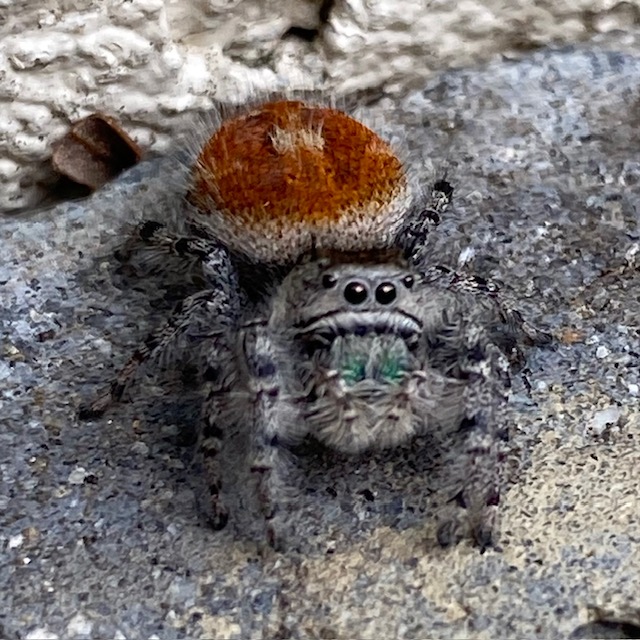
Arachnophobia is pretty bad, but disappearing spiders are much scarier.
Popular Science – Published Nov 12, 2023 9:00 PM EST
This article was originally featured on Knowable Magazine.
I’m obsessed with jumping spiders. But it wasn’t always so.
While never a spider hater or arachnophobe, I was pretty ambivalent about them for most of my life. Then I learned about jumping spiders: I’ve reported on their impressive vision (as good as a cat’s in some ways!), their surprising smarts (they make plans!) and the discovery that they have REM sleep (and may even dream!). I was hooked.
I also learned that jumping spiders may be in decline. In tropical forests, it used to be easy to find them in a matter of minutes, says behavioral biologist Ximena Nelson, who studies jumping spiders at the University of Canterbury in Christchurch, New Zealand. But for some species, that’s changed over the last couple decades. “Now, I mean, you just can’t find them at all in some cases.”
In fact, all over the world, all sorts of spiders seem to be disappearing, says conservation biologist Pedro Cardoso of the University of Lisbon. He and a colleague polled a hundred spider experts and enthusiasts globally about the threats facing the animals. “It’s more or less unanimous that something is happening,” he says.
But there are no hard data to prove this. Why not? There are likely a number of reasons, but one possible contributor keeps coming up in my conversations with arachnologists: People really do not like spiders. Even among the least popular animals on Earth, they are especially reviled. One recent study found that people think spiders are the absolute worst combination of scary and disgusting, beating out vipers, wasps, maggots and cockroaches.
It’s obvious why this is a problem for the house spider who ends up on the receiving end of a rolled-up newspaper. But if our distaste means scientists have a hard time finding the funds to study them, as some suspect is true, it’s also a problem for spiders writ large. For most potentially endangered spiders, there aren’t enough data to consider them for protection. We can’t help spiders if we don’t know which species are in trouble, or where and why they’re disappearing. And if you don’t care about the loss of spiders for their own sake, consider that crashing spider populations are bad news for a whole host of animals—including us.
The case for why people should care about spiders is robust. First, the vast majority of spiders do not bite or harm people, despite rampant misinformation in the media that would have you believe most spiders are out to get you. In reality, a vanishingly small number of spiders are dangerous to humans. Instead, they prey on insects—including mosquitoes, cockroaches and aphids—that actually do cause harm to people in their homes, gardens and fields. Spiders are excellent natural pest controls, but they are often killed by pesticides aimed at those same insect pests. These toxic chemicals also harm people.
Spiders are important food sources for birds, fish, lizards and small mammals. And there are untapped benefits we humans could enjoy someday—if spiders don’t disappear first—such as potential pharmaceutical and pest control applications derived from compounds in their venom, and medical and engineering applications based on their incredibly strong silk.
None of this is likely to overcome the visceral aversion so many people feel. The fear and disgust is so strong and specific that some scientists have suggested spiders represent a unique cognitive category in our minds. Ask people to name a phobia, and I’ll bet arachnophobia is the first one they think of.
But there may be a way to address the animus and the data gap at the same time: We should all start counting spiders.
 CNM VIP Voice