
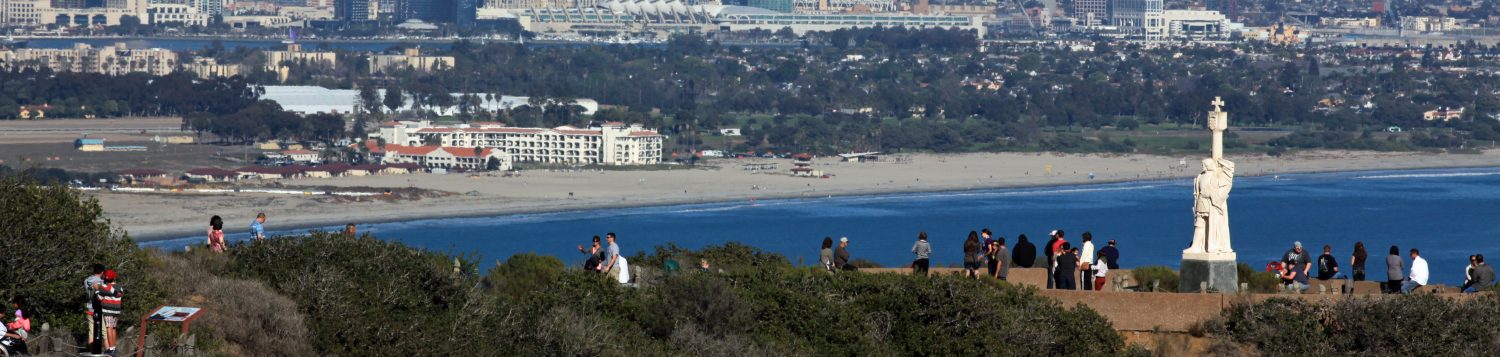
Cacti are fascinating plants. Their adaptation to warm dry climates is remarkable. They are very unique plants because of it. For example, did you know that the green part of the cactus is the stem of the cactus and the spines are modified leaves! Because the “leaves” are so modified, the stem is in charge of photosynthesis, hence the green color from the chlorophyll.
San Diego Barrel Cactus (Ferocactus viridescens)
The San Diego Barrel Cactus is listed as “seriously threatened in California”. It is a favorite of Cactus Chimney Bees (Genus Diadasia). There are a lot of Barrel Cacti on the Oceanside Trail. If you look closely, you may see the penny-sized holes on the ground from Chimney Bees’ nests. There are nesting aggregations both at the top of the trail and in the coastal areas, nearer to the Golden-spine Cereus. That said, these bees are solitary: a female will not share her burrow with another female. The San Diego Barrel Cactus is easy to recognize: it is round and ribbed. The Flowers (April/May) are concentrated at the center of the barrel. The fruits resemble mini red pineapples.


Coast Cholla (Cylindropuntia prolifera)
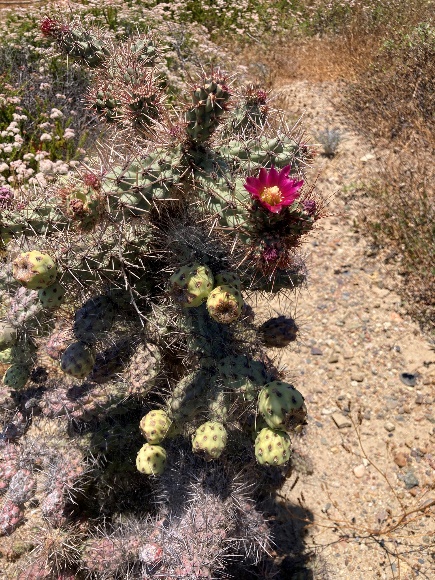
The Coast Cholla is part of a number of Cholla species called Jumping Chollas. The flowers are sterile, so there’s no sexual reproduction. The plant must drop some of its branches somewhere else in order to “proliferate”. In essence, the branch must “jump off” to find a new home and create a new cactus. This occurs when an animal, VIP or Ranger brushes a little too close to the Cholla. The barbed spines lodge themselves into the flesh. When the pain becomes too great, it is with great discomfort that we must part from our new friend, often a difficult task involving many more prickly episodes. The barbed spines do not come out easily. In fact, in severe cases, surgical removal is recommended to minimize tissue damage. Once removed, the discarded piece of Cholla will gladly root itself to the ground and become its own torture device. The Coast Cholla can be recognized from its pink flowers and stubby round stems. On the OT trail, Coast Cholla is seen in the Coastal Areas, below Cabrillo Road.
Cholla (Cylindropuntia)
We know from molecular analysis that we have a couple of look-alike species of Cholla in the park. The Coast Cholla is more unique, with stubby stems and pink flowers. We also know we have California Cholla (Cylindropuntia californica) with longer stems and yellow flowers. But a recent molecular study by Dr. Jon Rebman from the San Diego Natural History Museum revealed a third species, which is very similar to California Cholla. So much so, I wouldn’t venture to guess which is which. So all I can say is that we have one of these two species on the upper slopes of the OT. If you encounter one of these Chollas in bloom, take photos of the flowers and post them on iNaturalist. This will help document potential differences between the two species.

Fishhook Cactus (Mammillaria dioica)
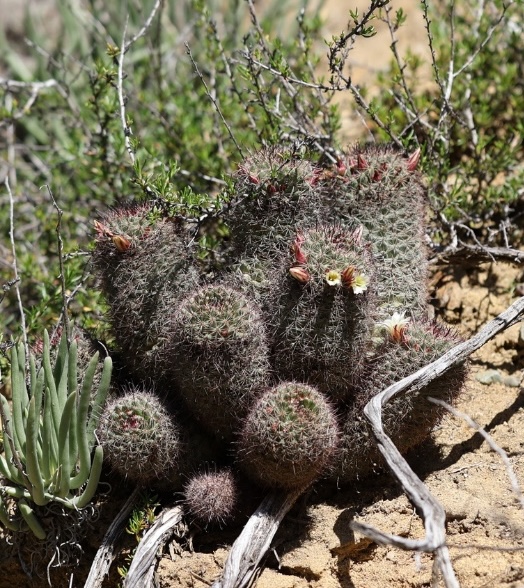
The Fishhook Cactus is possibly the most adorable cactus there is. The small curved spines almost look like fuzzy hair and one might be tempted to cuddle with the plant. But they are spines nonetheless, so stay clear! The Fishhook cactus is small in size, round to oblong and often grows in clusters. Peak bloom occurs in March, but more blooms may be seen at other times during the year. The small white to yellow flowers grow in the shape of a crown at the top of the cactus. The fruit resembles a mini red pepper.

Golden-spined Cereus (Bergerocactus emoryi)
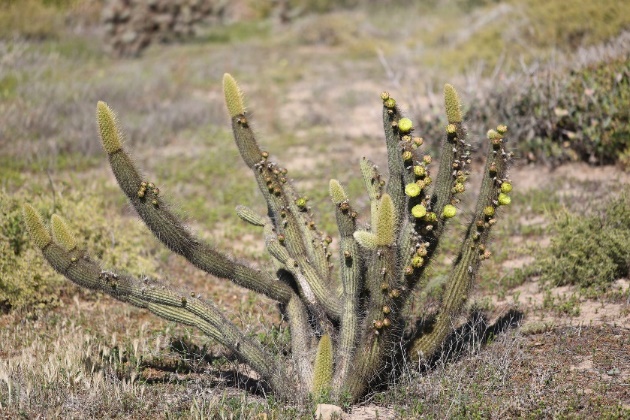
Also called Golden-club, Golden Snake or Velvet Cactus. In the US, the Golden-spined Cereus is found primarily on the coast of San Diego County, the Chanel Islands and into Baja California, Mexico. Due to habitat loss in San Diego, it is considered “fairly threatened” in California according to the California Native Plant Society. At the park, this cactus can be found on the lower part of the Oceanside Trail and coastal areas closer to parking lot 1. There’s also a patch on the hill just west of the Lighthouse. It has yellow flowers (April) that bloom up and down along the stem of the plant. It is also a favorite of Cactus Chimney Bees.
Prickly Pear (Opuntia oricola/littoralis)
The Prickly Pear Cactus in the park is another complicated story, as far as species is concerned. We may have several species and some are easier to tell apart than others. The most common seems to be the Chaparral Prickly Pear (Opuntia oricola). It has round-shaped “pads”. But we also have the Coast Prickly Pear (Opuntia littoralis). The pads are elongated. These are found in a lot of areas that were replanted in the 80s and 90s. The most famous one is the large prickly pear found in the breezeway, by the vending machines. For a while, I was not able to find any Coast Prickly Pear plants that weren’t in replanted areas, which begged the question: was the Coast Prickly Pear imported from nurseries during habitat restoration events of days-gone-by or does it actually occur naturally in the park. I was finally able to locate it in a remote, non-restored area. There is also a collection from 1937 on Point Loma that indicates the Coast Prickly Pear was present on the peninsula at that time.

To complicate matters, we have plants that seem to have a mind of their own and have some round and some elongated pads. These may be hybrids, possibly a result of the two species afore mentioned or possibly a hybrid that was imported to the park during restoration events. Or maybe there are no hybrids at all. Some botanists call them Opuntia semispinosa. But the genus Opuntia is under revision and molecular analysis are underway. This work might reveal new stories and new species.
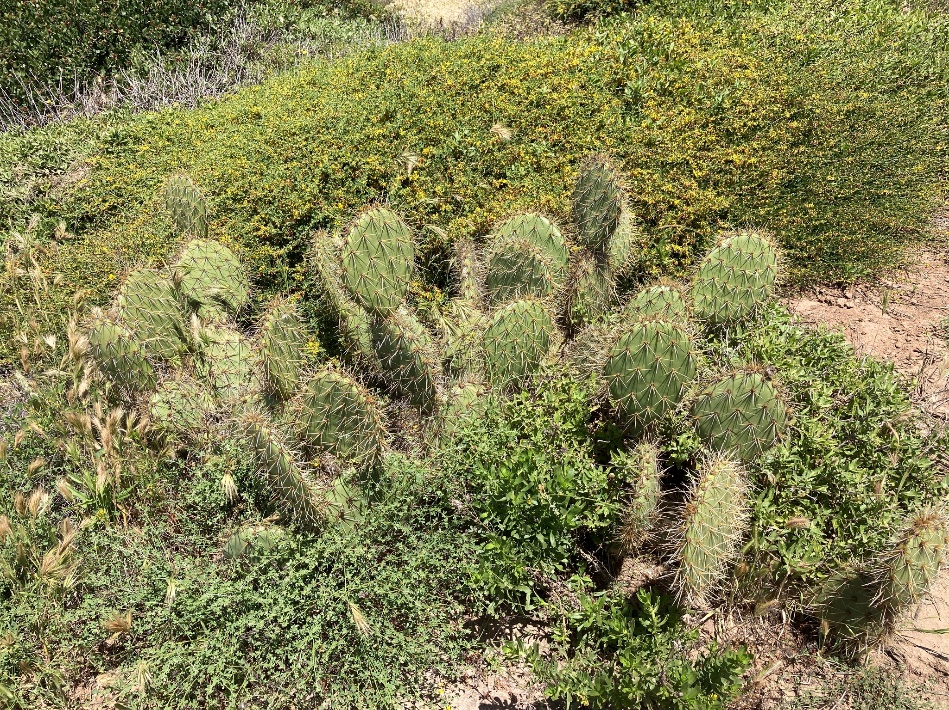
The prickly pear cactus is a staple food for the Kumeyaay and many other indigenous people. The pads, once stripped of their deadly spines, can be cooked and consumed. You may know them as “nopales”. They can be found in some grocery store. The Fruit is also delicious. They are called “tunas” (not to be confused with the fish). They are often used for marmalade or to flavor drinks. Tunas require a fair amount of processing since there are miniature spines on them. In fact, never handle tunas with bare hands, or you will regret it for the rest of the week, if not longer.

Last revised 10-Jun-25
 CNM VIP Voice
One thought on “Cacti”