A lighthouse and pine tree in shadow at sunset. The words Did You Know are in blue at the base of the image

Did You Know – How Did Point Loma Get Named?

“The long neck of land enclosing North San Diego Bay on the West side is known as Point Loma. The origin of the name comes from a legend of a flaxen haired little Russian girl, the sole survivor of a shipwreck, who was found wandering on shore. The local residents took her in and named her Loma and she grew up to become the cynosure … Continue reading Did You Know – How Did Point Loma Get Named?

The image shows a coastal scene during what appears to be either sunrise or sunset, as the lighting is warm and golden. In the foreground, there are large, rugged rocks with patches of green algae or moss. The rocky shoreline extends into the distance, with the ocean on the right side of the image. The water is relatively calm, with gentle waves lapping against the rocks. On the left side, there is a cliff with a reddish-brown hue, and a few structures can be seen on top of it, possibly buildings or fences. The sky is clear with a soft gradient from blue to a light orange near the horizon. A few birds are flying in the sky above the cliffs.

This Is Why We Protect Our Tidepools

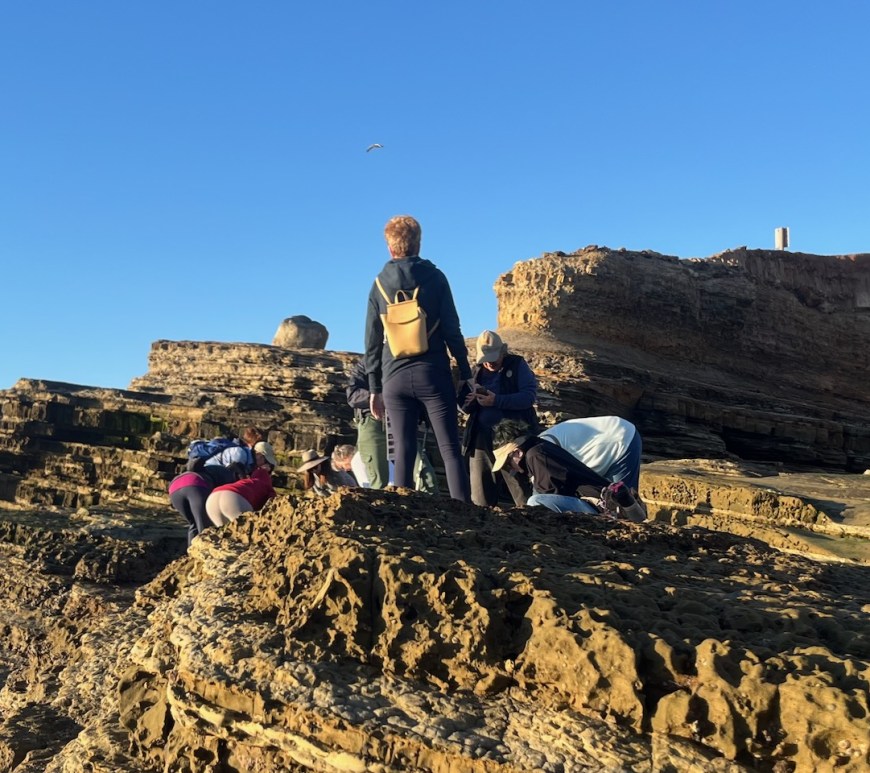
This news report demonstrates why our Tidepool Protection, Education, and Restoration Program (TPERP) volunteers are so important in protecting our tidepools and educating the public in how to care for the delicate resource. The news report, from Channel 8, is from the recent king tides exposing the tidepools in La Jolla. https://www.cbs8.com/article/news/local/crowds-at-san-diego-tide-pools-ignore-laws-disturb-marine-life-during-king-tides/509-b896eadc-c394-49f2-951d-6d981b75750f Consider signing up as a TPERP volunteer and help protect the tidepools and … Continue reading This Is Why We Protect Our Tidepools

A multi-branched cactus growing in a dry, grassy landscape. The cactus has long, upright arms covered in spines, with some arms bearing clusters of round, yellowish buds or fruit. The ground around the cactus is a mix of sparse grass and bare soil, and the background is filled with more dry vegetation. The overall scene suggests an arid or semi-arid environment.

Cacti at Cabrillo National Monument

Science Technician Patricia has created a guide describing all the cacti at Cabrillo. This guide will help volunteers identify the different types of cacti for visitors as they move around the park. Patricia says that all the different types of cacti can be found along the Oceanside Trail. You can find the new cacti guide as part of the ebinder in the Terrestrial Plants section. … Continue reading Cacti at Cabrillo National Monument