Oceanside Trail Interpretative Plant Guide

SHRUBS
Mojave Yucca (Yucca schidigera). Blooms April-May. Used by the Kumeyaay for food (blooms) and for fibers (leaves) to make sacs and sandals. Points of leaves used for needle work and tatoos. The Mojave Yucca is only pollinated by one insect: the Yucca Moth. We know we don’t have Yucca Moths in the park anymore because our Yuccas never produce any seed. This is a true story of obligate mutualism, where both the plant and the moth rely on each other in order to survive. The Yucca moth adults have a very short life. They do not have feeding mouth parts so they cannot feed (they do all their eating/growing at the caterpillar stage). They only live long enough to mate and reproduce, then they starve to death. After mating and in order to reproduce, a female moth will collect pollen from the anthers (male pollen-producing part of the flower) of a Yucca plant, carry it to another Yucca plant and deposit the pollen in the stigma (female part of the flower), hence cross-pollinating the plant. She will then deposit a few eggs in the ovary of the flower, right below the stigma, where the seeds will eventually develop.

The image shows a desert plant, likely a yucca, with long, pointed green leaves radiating from a central point. The plant has tall flower stalks with clusters of pale yellow, bell-shaped flowers. It is situated in a natural setting with other green vegetation and shrubs in the background. The ground is covered with grass and small plants. The sky is partly cloudy.
Mojave Yucca (Yucca schidigera); NPS Photo/P. Simpson


These eggs will hatch at about the same time the plant will have produced seeds and the moth larva will feed on some of these seeds (not all, some seeds will drop to the ground and create new Yuccas!). When the caterpillars have reached maximum size, they will fall to the ground and pupate, only to emerge the following season when the sweet smell of the Yucca blooms prompt them to come out of their cocoons. And the cycle starts all over again.

The image shows a close-up of a small white moth resting on a textured surface, possibly fabric. The moth has a slender body and long antennae. Its wings are folded back along its body, and they appear to be a soft white color with a slightly fluffy texture at the edges. The moth's legs are thin and light brown, and its head is small with dark eyes.
Yucca Moth (genus Tegeticula);Photo: Gary Nunn

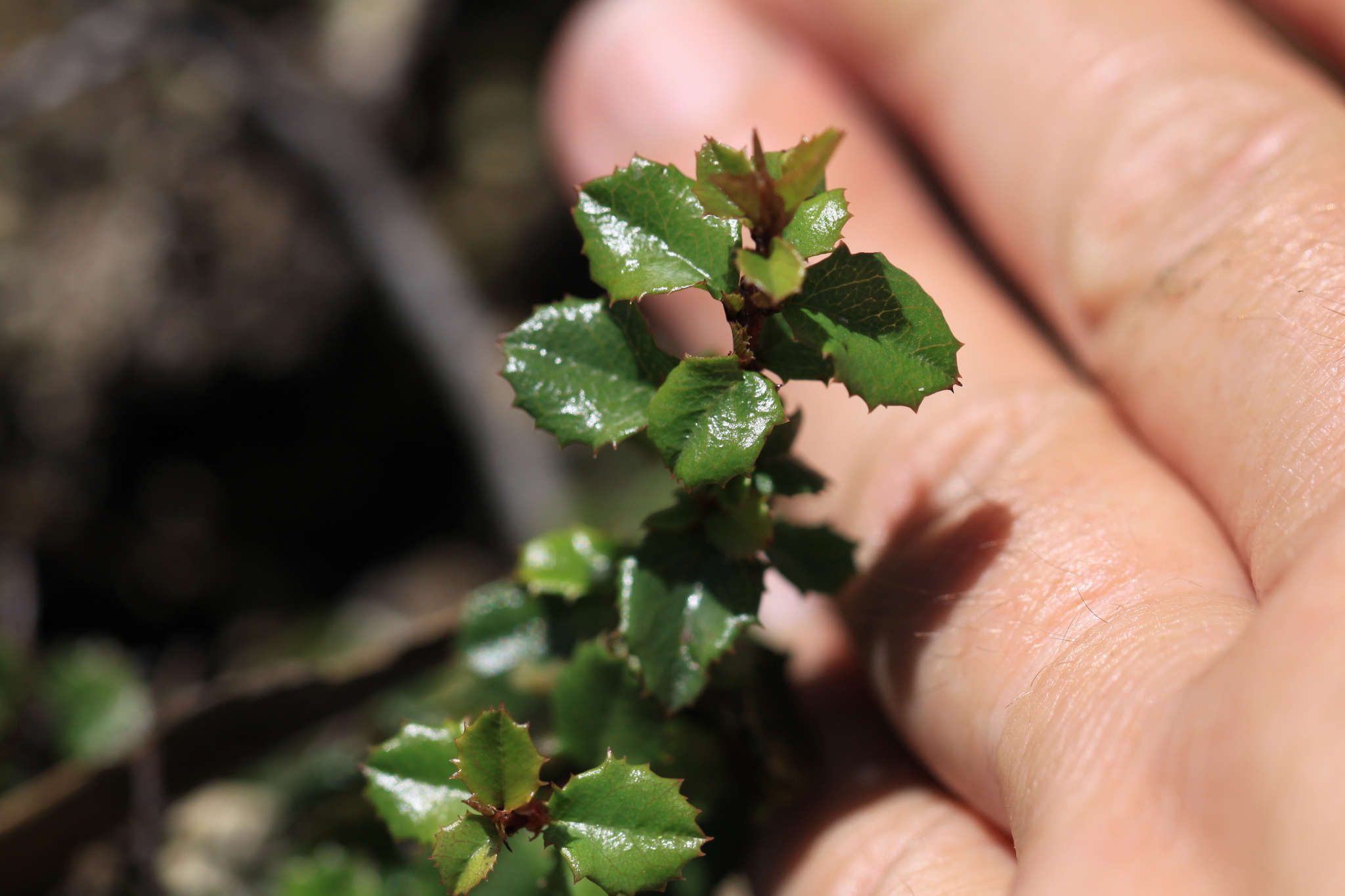
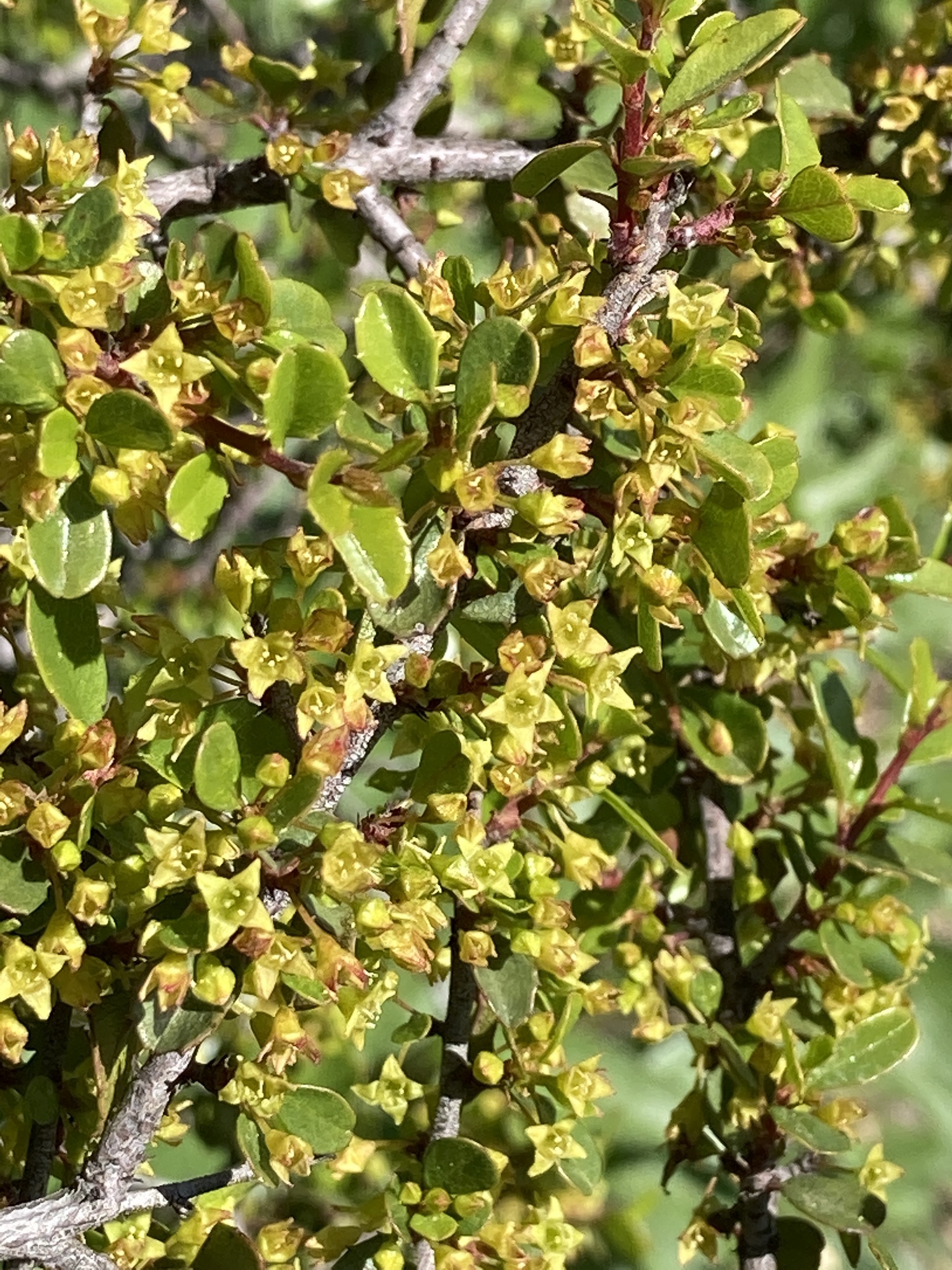
Redberry Buckthorn (Rhamnus crocea). Also known as Spiny Redberry. Smaller wooden shrub with Holly-like small leaves. Small discrete pale green flowers (Feb-Mar), fruits are bright red berries (May-June). The plant is dioecious (pronounced die-ee-shus), which means a single plant is either male or female. The flowers on the male bush only have male parts and the flowers on the female bush only have female parts. That means only female bushes bear fruit. Berries were consumed by Kumeyaay. The plant is native to US West Coast and Northwestern Mexico.
Chapparal Bushmallow (malacothamnus fasciculatus). The Chapparal Bushmallow is one of the most spectacular shrubs in the park when it is in bloom (May-July). Its long whipping branches are adorned with cup-shaped pink flowers. In full bloom, one plant can have thousands of flowers. The bushmallow flowers attract many pollinators for various reasons. It blooms in later spring to summer, at a time when most other spring flowers are gone or on their way out. That is excellent timing to sustain native bee populations into the summer. The cup-shaped flowers also make excellent sleep chambers for bees. Early in the morning and if you’re lucky, you may find a drowsy resident snoozing in a bloom.

The image shows a scenic view of a coastal area. In the foreground, there is a bush with numerous small, light pink flowers. The bush is growing on a dry, rocky terrain with some brownish vegetation around it. In the background, there is a vast expanse of blue water, likely the ocean, with a clear blue sky above. On the horizon, you can see a distant shoreline with some low hills or mountains. The overall scene is bright and sunny, suggesting a clear day.
Chapparal Bushmallow (malacothamnus fasciculatus); NPS Photo/P. Simpson

The Chapparal Bushmallow also attracts a very special bee called the Ochraceous Chimney Bee (Diadasia ochracea). This bee only visits native plants in the Mallow family and at the park, that means it is found exclusively on the Chapparal Bushmallow. This means the life cycle of these bees are tightly tied to the blooming cycle of the bushmallow. Like the majority of our native bees, The Ochraceous Chimney Bee is a solitary ground nesting bee. It is slightly larger than a honey bee, very hairy with pale yellow hair on its legs, abdomen and head. It also has gorgeous pale blue eyes!
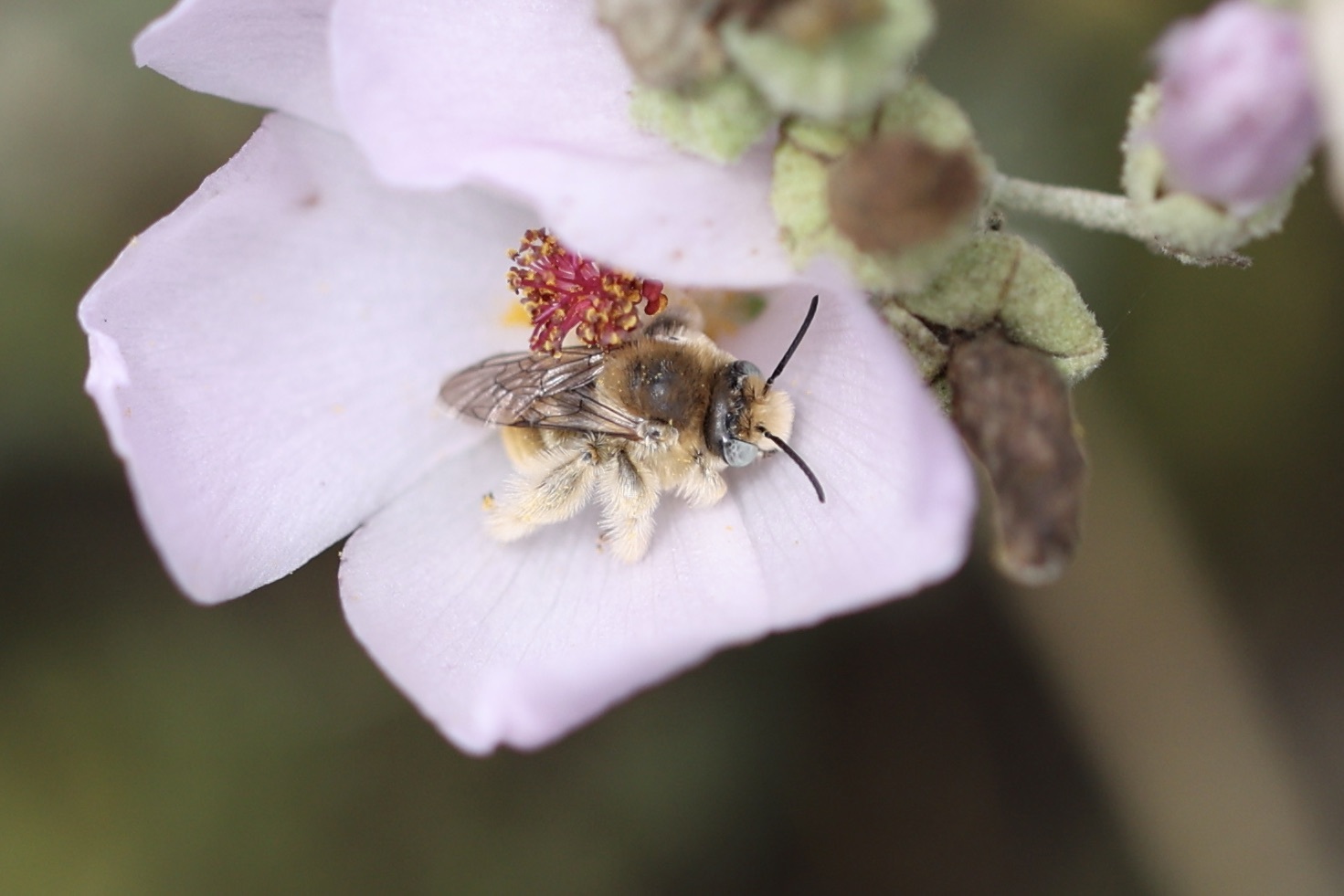
The image shows a close-up of a bee resting on a light pink flower. The bee is covered in fine hairs and has translucent wings. Its body is a mix of brown and black, with prominent antennae. The flower has delicate petals and a cluster of small, red and yellow stamens at its center. The background is blurred, highlighting the bee and the flower as the main subjects of the image.
Ochraceous Chimney Bee; NPS Photo/P. Simpson
The image shows a close-up of a metallic green bee inside a light purple flower. The bee is nestled against the flower's stamen, which is red with yellow tips. The bee's body is iridescent, displaying shades of green and blue, and its wings are partially visible. The flower petals create a soft, blurred frame around the bee, focusing attention on the insect and the stamen.
Texas Striped Sweat Bee resting in bushmallow bloom; NPS Photo/P. Simpson

Cliff Spurge (Euphorbia misera). The cliff spurge is a staple shrub at CNM. It is a semi-succulent drought deciduous plant. During really dry years, the cliff spurge looks indeed quite miserable (see Latin name) as all the leaves fall and all that is left are the crooked and knobby naked branches. During better years, the ovate taco-shaped leaves may remain on the plant year round. One particularity of plants in the genus Euphorbia is that a milky sap escapes from the branches/leaves when damaged. Another remarkable trait for Euphorbia plants is the flowers, which are morphologically very different from traditional flowers and called cyathium. What looks like white petals are actually bracts that are adorned with red or green/yellow nectar glands. The Cliff Spurge “flowers” can be found blooming year-round. Not all shrubs will be in bloom at the same time, but you’ll most likely find at least one shrub in any given month that has flowers on it. The nectar pads are often irresistible to pollinators large and small, especially at times of year when other nectar sources are scarce. California Native Plant Society considers this plant rare (“fairly threatened in California”) due to habitat loss.
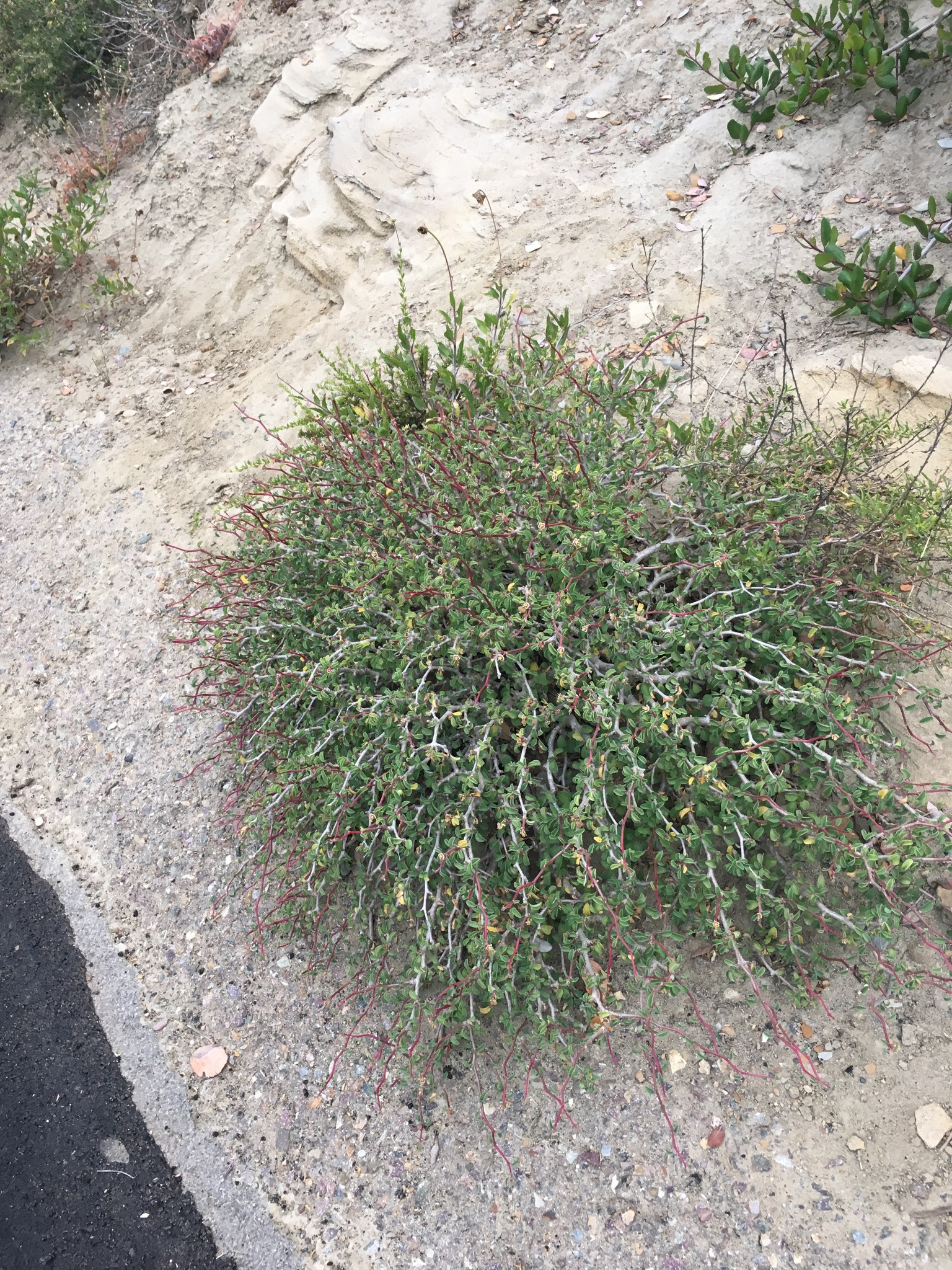
The image shows a bushy plant growing on a sandy and rocky slope. The plant has numerous thin, red stems with small green leaves. The surrounding area is a mix of sandy soil and small rocks, with some patches of vegetation visible in the background. The edge of a paved surface, possibly a road or path, is visible on the left side of the image. The overall setting appears to be a natural, possibly arid or semi-arid environment.
Cliff Spurge (Euphorbia misera); NPS Photo/P. Simpson

ANNUALS
San Diego Creeper (Aphanisma blitoides). The San Diego Creeper is the only plant in the genus Aphanisma. It is sometimes called San Diego Coastalcreeper. It is a rare annual that likes the coastline of Southern California (including the Channel Islands) and Baja California (Mar-May). Because coastal habitat has dwindled rapidly in the last 50+ years, the plant is considered “fairly threatened” and is monitored closely at the park and in other San Diego locations. Aphanisma spreads on the ground (Feb/Jun), first with green lance-shaped leaves, then the stems and leaves turn red and later brown as it dies off for the season.

The image shows a patch of ground covered with low-growing plants. The plants have small, narrow leaves that are a mix of green and reddish hues, giving them a vibrant appearance. Among these plants, there are some areas with bright green, bushier foliage. The ground is visible in some spots, with dry twigs and soil scattered around. The overall scene suggests a natural, possibly wild, setting with a variety of ground-covering vegetation.
San Diego Creeper (Aphanisma blitoides); NPS Photo/P. Simpson
The image shows a patch of dry, rocky soil with a plant growing in it. The plant has thin, reddish stems that spread outwards and are covered with small, narrow leaves. There are also small clusters of tiny white flowers scattered among the stems. Around the plant, the ground is covered with small rocks and pebbles, and there are patches of green vegetation nearby. The overall setting appears to be a dry, arid environment.
San Diego Creeper (Aphanisma blitoides); NPS Photo/P. Simpson

Nuttall’s or Lesser Snapdragon (Sairocarpus nuttallianus or pusillus). We have two species of these delicate annual snapdragons at the park: The Nuttall’s Snapdragon and the Lesser Snapdragon. They look almost identical with hairy stems and leaves, and purple pitcher-shaped flowers (Apr-May). They can grow upright or in a somewhat vine-like matter.
The Nuttall’s Snapdragon (A) has shorter and denser hair on the stems and leaves, which give a plant a softer, often lighter green look. Think of it this way: it looks cuddly and you want to cuddle with Mr. Nuttall’s plant. The Lesser snapdragon (B) has slightly longer and sparcer hair. The hair is also more glandular, which means it has a larger gland at the end of it, hence appearing more “knoby”. Guess what: you want to cuddle “less” with this one!
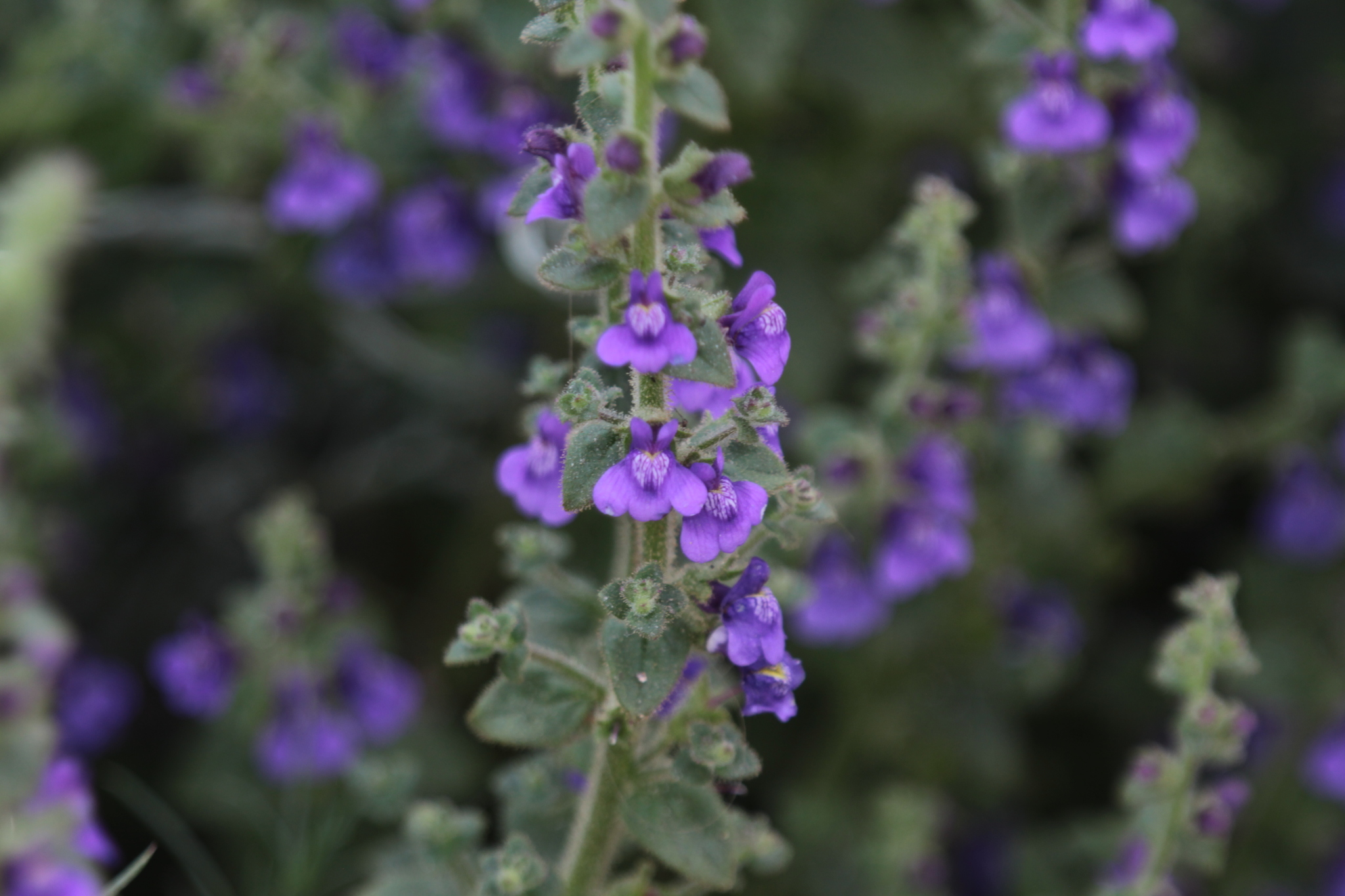
The image shows a close-up of a flowering plant with small, vibrant purple flowers. The flowers are arranged along a vertical stem, and each flower has a tubular shape with a slightly open mouth, revealing a lighter, almost white interior. The leaves are small, green, and slightly fuzzy, growing along the stem. The background is blurred, highlighting the main stem and flowers in the foreground. The overall impression is of a lush, colorful plant in bloom.
Nuttall’s Snapdragon (Sairocarpus nuttallianus); NPS Photo/P. Simpson
The image shows a close-up of a plant stem with small, green, oval-shaped leaves. The stem and leaves are covered in tiny, fine hairs, giving them a fuzzy appearance. There is a small insect, possibly an aphid, on one of the leaves. In the background, there is a hint of a purple flower, slightly out of focus. A finger is visible behind the stem, likely holding or supporting the plant for the photograph.
A-Nuttall’s Snapdragon; NPS Photo/P. Simpson
The image shows a close-up of a plant with vibrant purple flowers and green leaves. The flowers have a tubular shape with a slightly flared opening, and the petals have intricate white patterns. The stem and leaves are covered in fine, white hairs, giving them a fuzzy appearance. The plant is being held by a person's fingers, which are visible in the background, providing a sense of scale. The overall scene is set outdoors, likely in a garden or natural setting.
B-Lesser Snapdragon; NPS Photo/P. Simpson


Texas Toadflax (Nuttallanthus texanus). The Texas Toadflax flower (Mar-Apr) looks similar to the Nuttall’s Snapdragon. However, the plant is usually smaller, the flowers smaller, paler and more delicate, and the stems slender with narrow lance-like leaves. Stems and leaves are usually hairless. This plant occurs from coast to coast in the US (Washington to Florida), but not in all northern states.

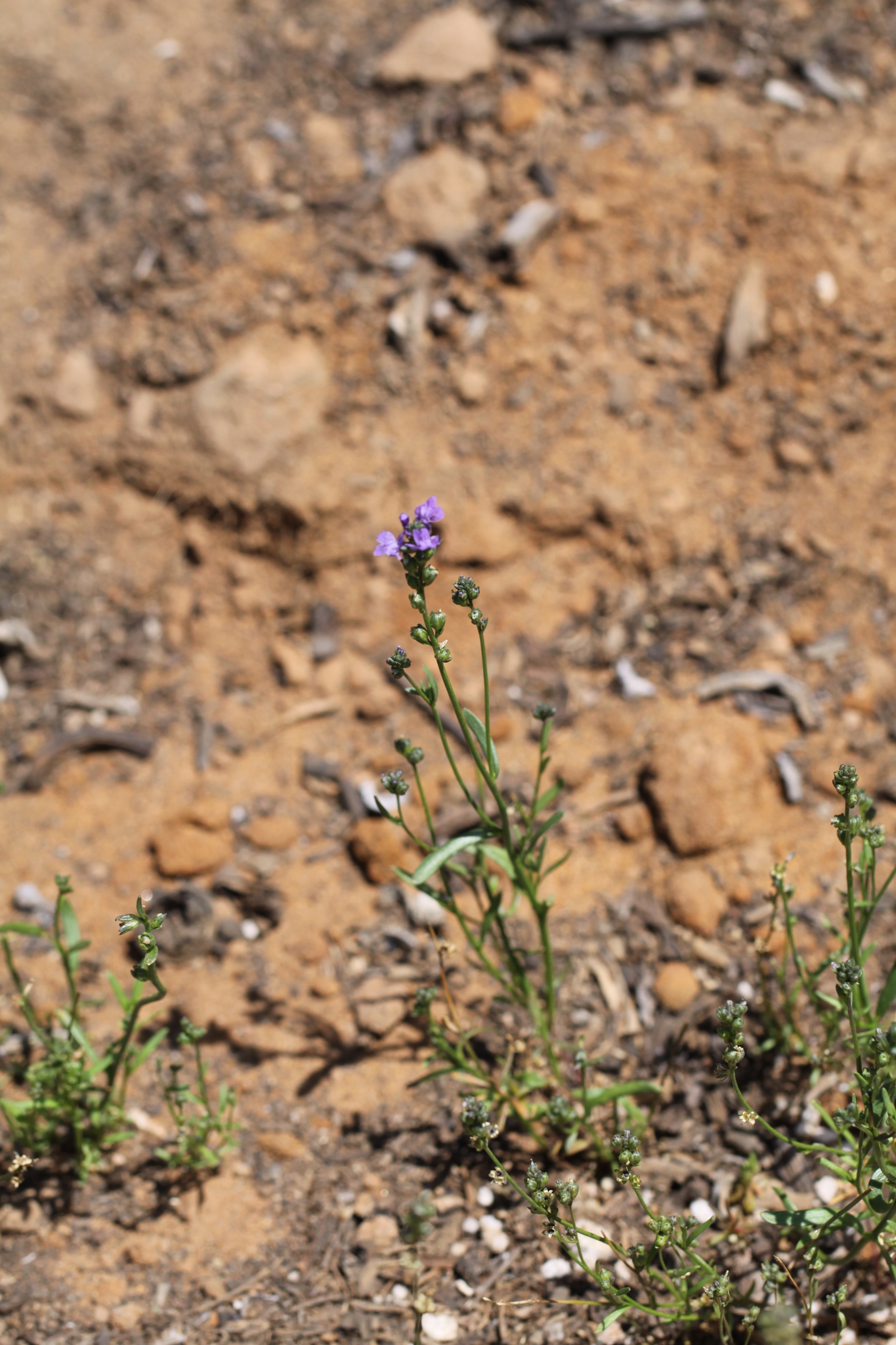
The image shows a close-up of a small, delicate purple flower being held between a person's thumb and forefinger. The flower has four petals with a slightly crinkled texture. The background is blurred, with a warm, earthy tone, which helps to highlight the flower in the foreground. The person's hand is in focus, showing the details of the skin and the way the fingers are gently holding the flower.
Texas Toadflax (Nuttallanthus texanus); NPS Photo/P. Simpson

Lineleaf Whitepuff (Oligomeris linifolia). Let’s hear it for the none-showy plants! Oligomeris is the poster child in that category. It is a small plant with long slender leaves and a discrete inflorescence (Feb-Apr). The flowers are very small and only have two small white petals that are barely visible to the naked eye. But a flower is a flower, no matter how small. Lineleaf Whitpuff is native to several areas of the world, mostly sharing mediterranean or desert climates (Middle East, southern Europe, north Africa, southwestern US and northern Mexico). In San Diego, it can be found in coastal areas and in the desert, but nowhere in-between.
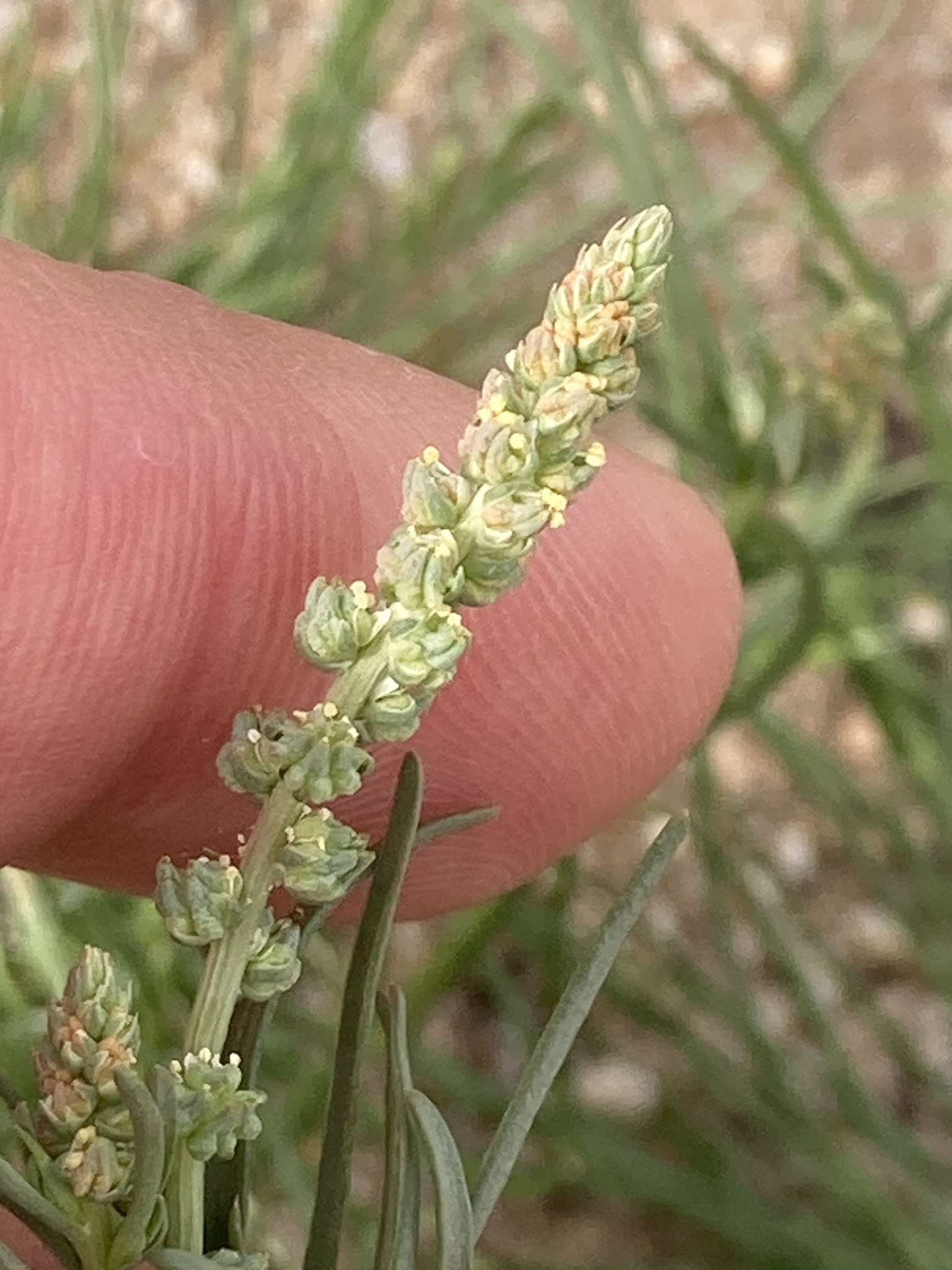
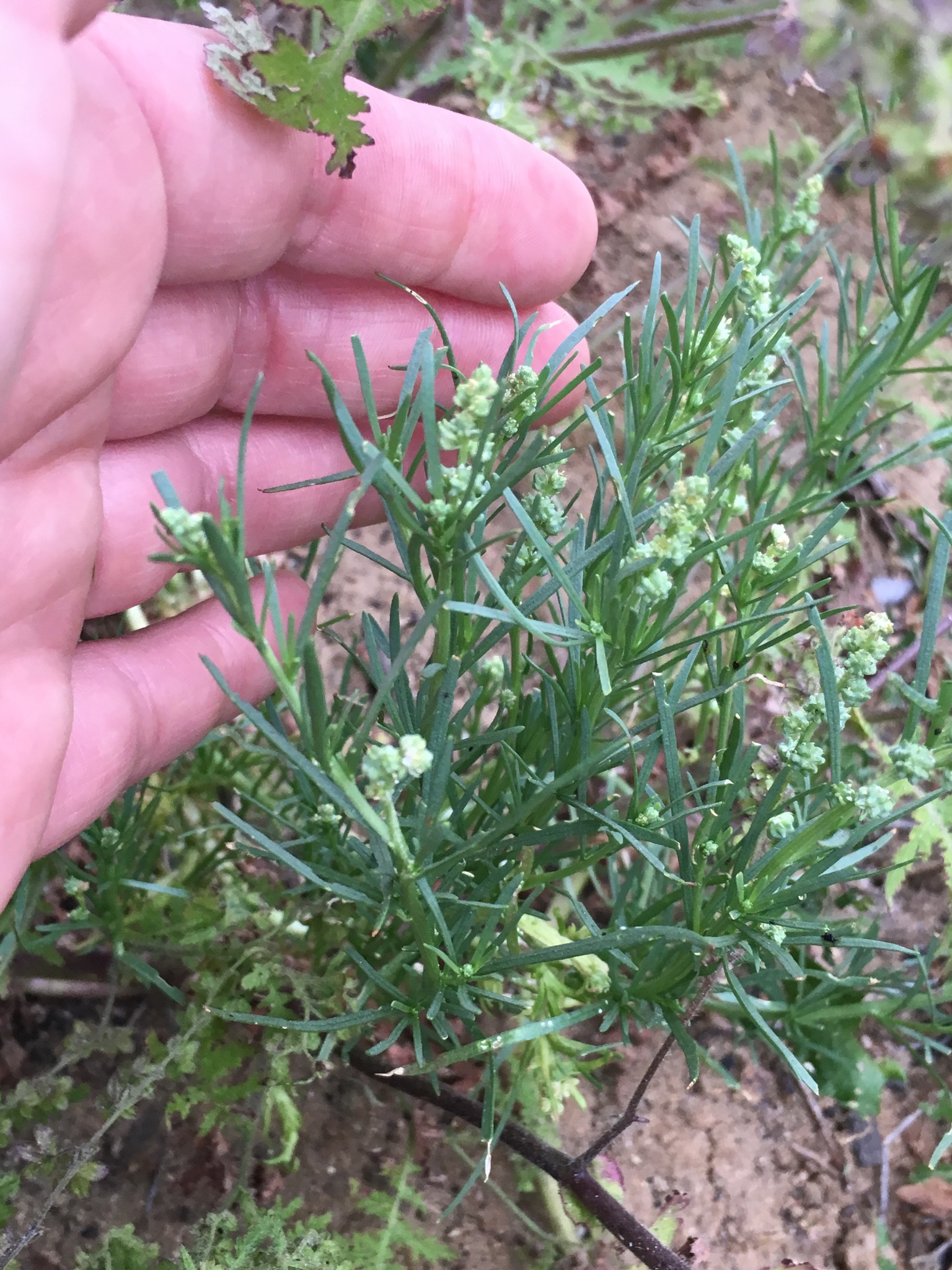
The image shows a close-up of a small plant being held between two fingers. The plant has a slender stem with a cluster of tiny, tightly packed buds or flowers at the top. The buds are light green with hints of yellow, and some have small yellowish tips, possibly indicating they are starting to bloom. The background is slightly blurred, showing more greenery and a sandy or gravelly surface.
Lineleaf Whitepuff (Oligomeris linifolia); NPS Photo/P. Simpson
The image shows a close-up of a small green plant with thin, needle-like leaves. The plant has small clusters of light green buds or flowers along its stems. A person's hand is gently holding or supporting the plant, providing a sense of scale. The background shows soil and other vegetation, indicating that the plant is growing outdoors.
Lineleaf Whitepuff (Oligomeris linifolia); NPS Photo/P. Simpson


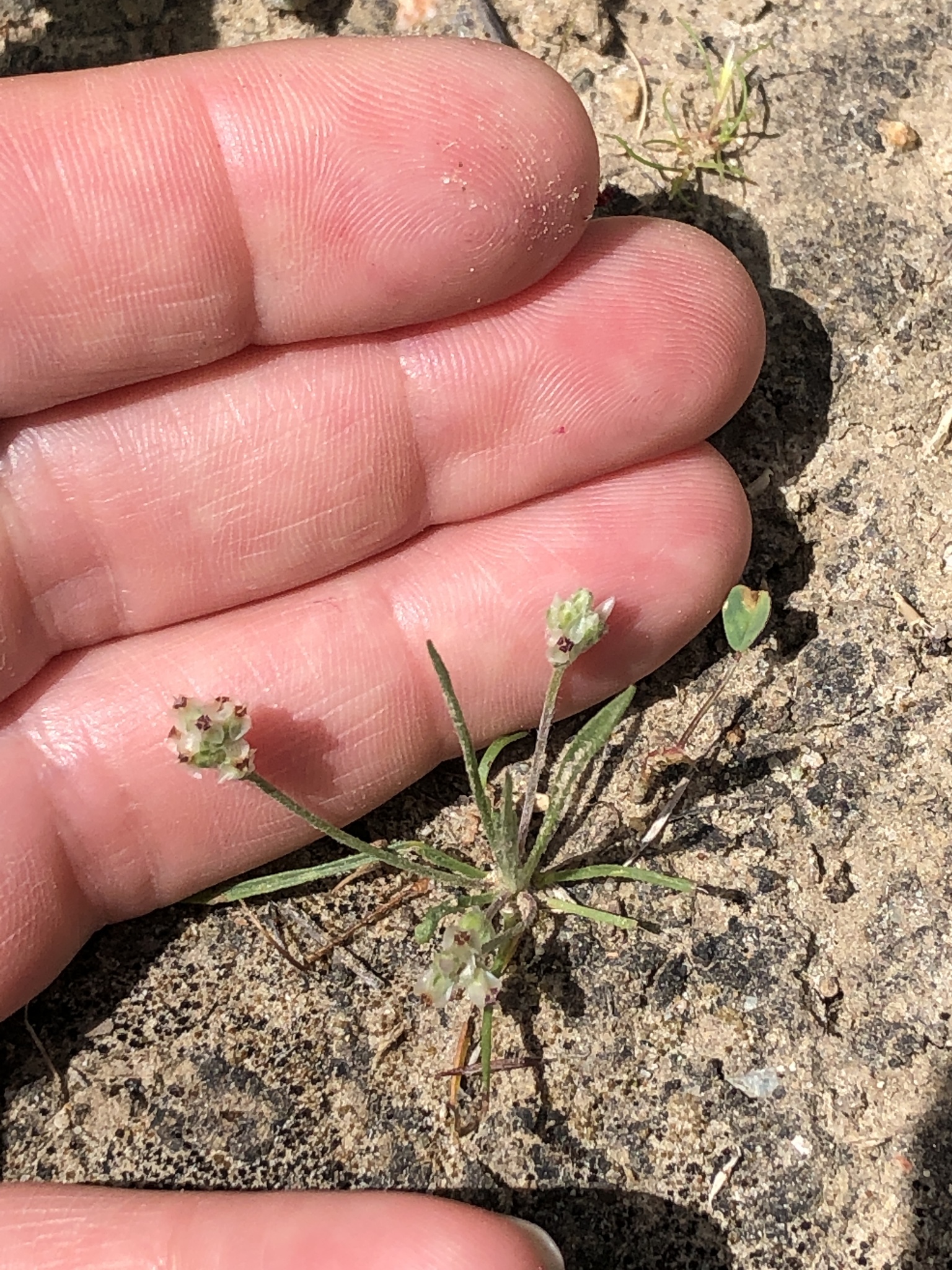
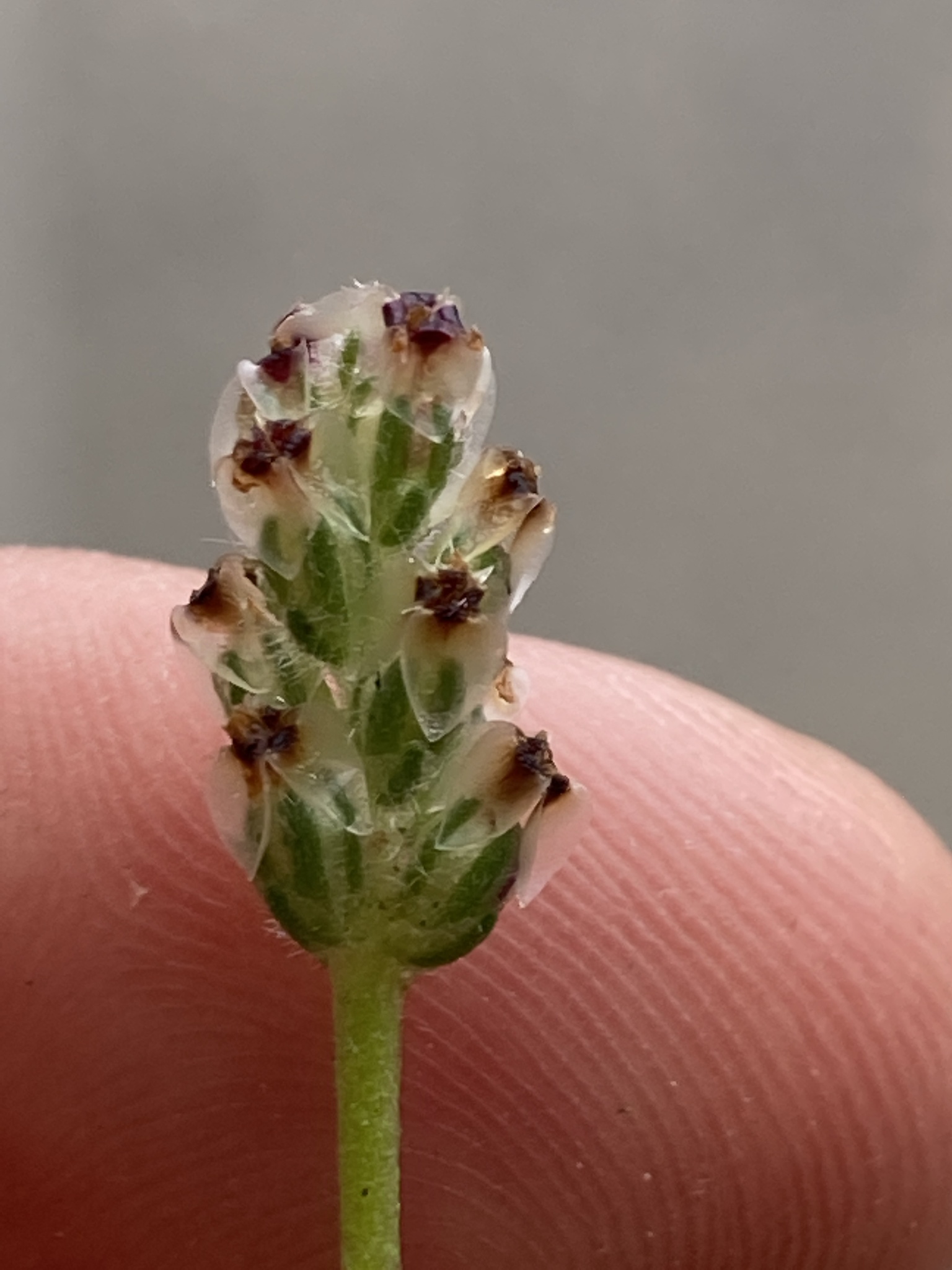
Dot-seed Plantain (Plantago erecta). The Dot-seed Plantain is a smaller plant with long needle-like basal leaves and elongated inflorescence with paper-like pale flowers. The flowers have a brown center that looks like… drum rolls… a dot on the inflorescence (Mar-May). A single plant can grow to about a foot wide, while other only grow to an inch or two. The Dot-seed Plantain, also called Dwarf Plantain, is one of the primary host plants for the endangered Quino Checkerspot Butterfly (Euphydryas editha quino), only found in Riverside County, San Diego County and Northern Baja California. Though the butterfly’s current range is Eastern San Diego county, it has been spotted near the coast in South Bay. Maybe someday, the Quino Checkerspot can call our park home!

The image shows a plant growing in sandy soil. The plant has long, slender green leaves that grow outward from the base. It features numerous tall, thin stalks that rise vertically from the center. These stalks are topped with small, densely packed flower spikes that appear to be in various stages of blooming, ranging from green to brown. The surrounding area is a mix of sandy soil and some other sparse vegetation. The lighting suggests that the photo was taken during the day, with sunlight casting shadows on the ground.
Dot-seed Plantain (Plantago erecta); NPS Photo/P. Simpson
The image shows a close-up of a small plant or flower bud being held between two fingers. The bud is green with small, translucent, petal-like structures that have dark brown or black tips. The background is out of focus, making the bud the central point of the image. The texture of the fingers is visible, indicating the small size of the bud.
Dot-seed Plantain (Plantago erecta); NPS Photo/P. Simpson
The image shows a close-up of a small plant growing in sandy soil. The plant has thin, elongated green leaves that spread out from the center. There are two small flower clusters on thin stems, each with tiny white flowers that have a hint of pink or red at the tips. A person's fingers are visible in the image, gently holding the plant to provide scale, showing that the plant is quite small. The soil appears dry and sandy, with some small rocks and debris scattered around.
Dot-seed Plantain (Plantago erecta); NPS Photo/P. Simpson

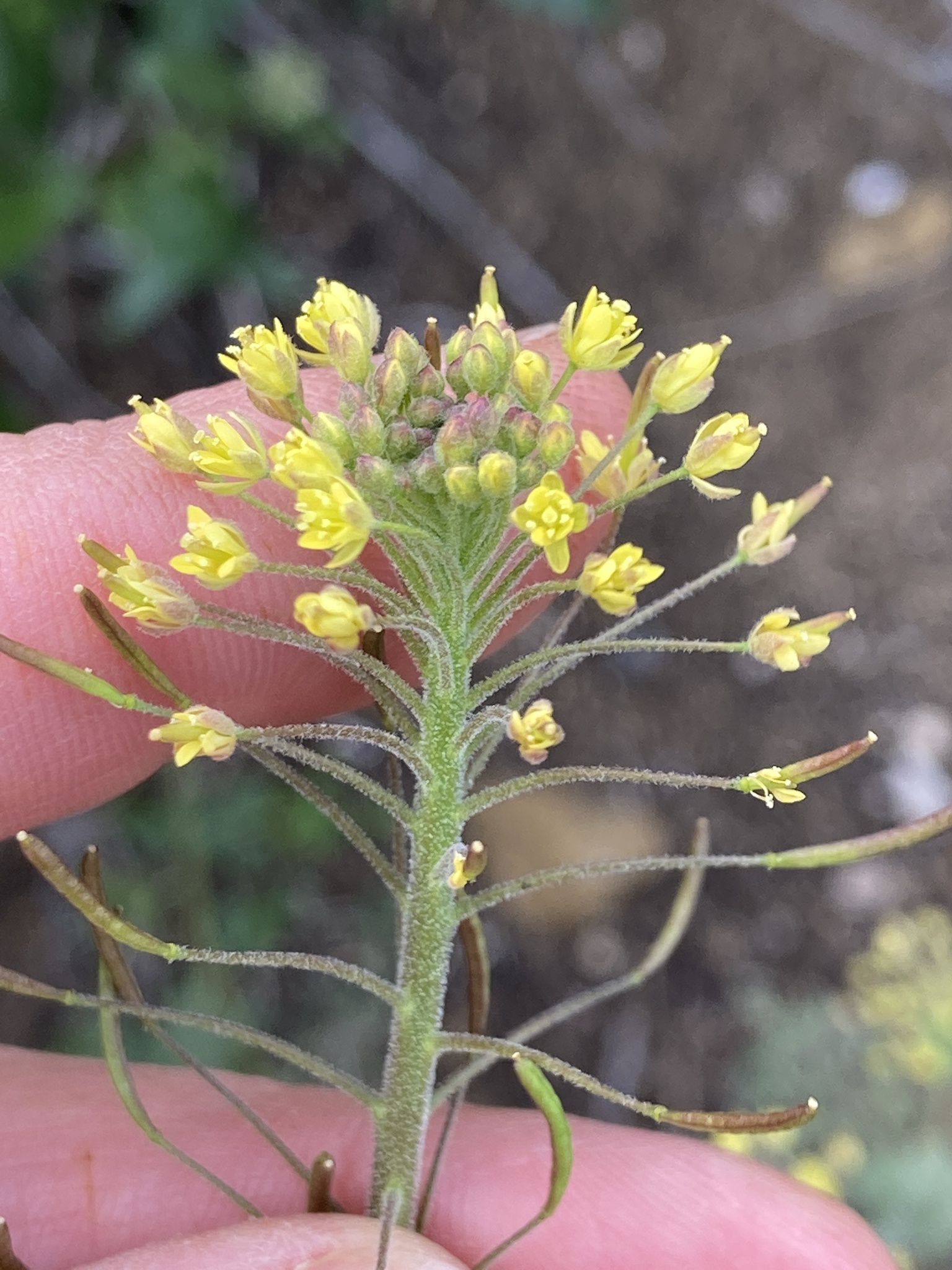
Western Tansymustard (Descurainia pinnata). The Western Tansymustard is a native species in the Mustard family (Brassicaceae). The park is home to a sub-species: Menzie’s Tansymustard (ssp. menziesii). A San Diego Natural History Museum report from 2007 mentions that these common plants “are in limited numbers at the park and should be included in conservation planning”. We are happy to report we now have a healthy population of Western Tansymustard! Systemic weed removals (thank you Weed Warriors!) in some areas have helped our local mustard re-populate many spaces around the park. This native mustard can easily be told apart from other non-native mustard from its leaves. Leaves are “highly divided with pointed, toothed lobes or leaflets”. Translation: leaves are skinny and not filled in. They are also more hairy than other mustards giving the plant an overall lighter green look. The seed are said to taste somewhat like black mustard and were utilized as food by Native American people such as the Navajo.

The image shows a patch of wild plants growing on a dirt surface. In the foreground, there is a plant with tall, thin stems and small clusters of yellow flowers at the top. The leaves of this plant are feathery and delicate. Surrounding this plant, there are other green plants with broader leaves. In the background, there is a dense shrub with dark green leaves. The ground is covered with dry twigs and small rocks.
Western Tansymustard (Descurainia pinnata); NPS Photo/P. Simpson
The image shows a close-up of a small plant with clusters of tiny yellow flowers. The flowers are arranged in a rounded cluster at the top of a green stem. The stem is covered with fine hairs and has several thin, elongated seed pods extending outward. A hand is holding the stem, providing a sense of scale, and the background is a blurred mix of earthy tones and greenery.
Western Tansymustard (Descurainia pinnata); NPS Photo/P. Simpson
The image shows a close-up of a person's hand gently holding a green plant. The plant has delicate, finely divided leaves that are feathery in appearance. The leaves are a muted green color, and the plant seems to have a soft texture. The background is filled with more of the same type of foliage, suggesting that the plant is part of a larger bush or cluster. The person's fingers are visible, providing a sense of scale to the size of the leaves.
Western Tansymustard (Descurainia pinnata); NPS Photo/P. Simpson


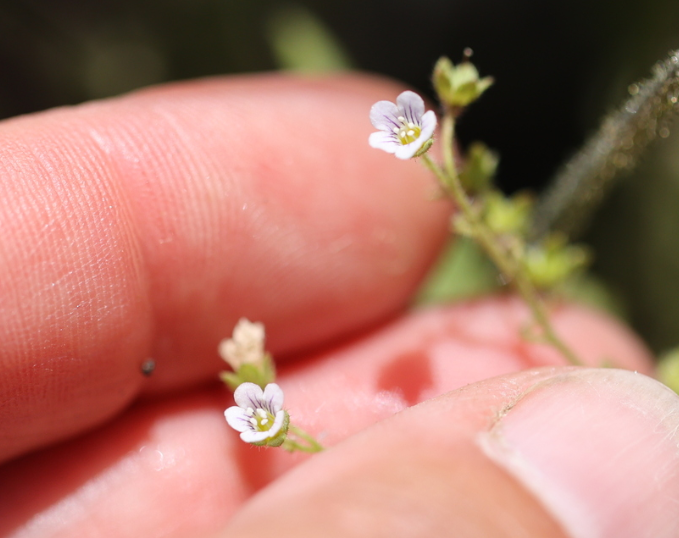
Common Eucrypta (Eucrypta chrysanthemifolia). Eucrypta, also called Spotted Hideseed, is an inconspicuous annual plant that often grows in the shadow of other plants. It has small discreet white flowers (Mar-Apr), often adorned with purple stripes in the center. The leaves are highly divided and lobed, similar to the leaves of Chrysanthemums. This is how this plant got its Latin name: chrysanthemifolia. In the park, we have another similar plant called Racemed Fiestaflower (Pholistoma racemosum), found on the Bayside Trail and Coastal Trail. It is easy to tell them apart with one simple test: smell the leaves. Eucrypta exhibits a strong herbal fragrance.

The image shows a small, green plant growing in a patch of reddish-brown soil. The plant has thin, delicate stems with small, finely divided leaves. There are tiny white flowers scattered throughout the plant. The surrounding area has more plants with similar foliage, and the soil appears dry and slightly compacted with some small pieces of organic debris. The background includes other types of vegetation with broader leaves.
Common Eucrypta (Eucrypta chrysanthemifolia); NPS Photo/P. Simpson
The image shows a close-up of a person's fingers gently holding a small, delicate plant with tiny flowers. The flowers are very small, with light purple petals and a white center. The plant appears to have a thin stem with small green leaves. The background is blurred, focusing attention on the flowers and fingers. The lighting is bright, highlighting the details of the flowers and the texture of the skin.
Common Eucrypta (Eucrypta chrysanthemifolia); NPS Photo/P. Simpson
The image shows a close-up of a small green plant being held between someone's fingers. The plant has delicate, fern-like leaves with a light green color. At the top of the plant, there are small clusters of green buds or seed pods. The background is slightly out of focus, showing a natural setting with soil and possibly other plants. The lighting suggests it is taken in daylight, with some shadows visible on the fingers and the plant.
Common Eucrypta (Eucrypta chrysanthemifolia); NPS Photo/P. Simpson

Cleveland’s Tobacco (Nicotiana clevelandii). Did you know that Cabrillo National Monument has its own species of Wild Tobacco? Now you do! And there is quite a bit of it on the Oceanside Trail, especially toward the bottom of the hill, just before Cabrillo Road. The plant first grows close to the ground as a flat rosette with wide ovate leaves (Jan-Feb). Later, one or multiple stems shoot out from the center of the rosette and grow upright to 20” or more. The stems are adorned with slender pointed leaves and small white trumpet-shaped flowers (Mar-Apr).
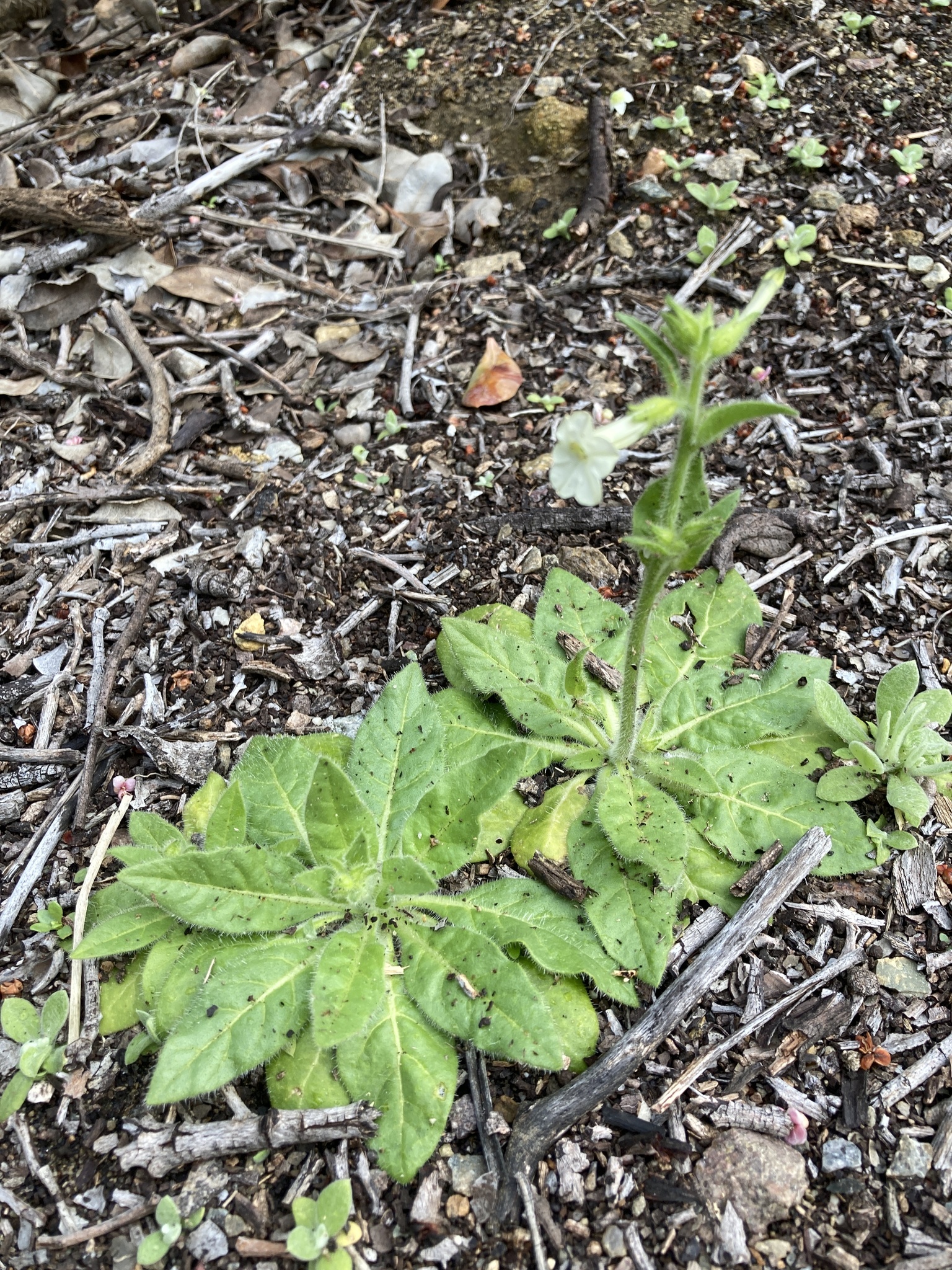
The image shows a small plant growing in a natural outdoor setting. The plant has a rosette of large, green, hairy leaves that spread out close to the ground. A single stem rises from the center of the rosette, bearing a small, white flower at the top. The surrounding ground is covered with dry leaves, twigs, and small bits of debris, indicating a forest or garden floor. There are also a few small green sprouts scattered around the area.
Cleveland’s Tobacco (Nicotiana clevelandii); NPS Photo/P. Simpson
The image shows a close-up of a person's hand holding a plant stem. The plant has small, white, tubular flowers and fuzzy green leaves. The background is a natural setting with more plants, including some with bright yellow flowers that resemble daisies or sunflowers. The ground appears to be rocky or gravelly. The focus is mainly on the plant being held, with the surrounding vegetation slightly blurred.
Cleveland’s Tobacco (Nicotiana clevelandii); NPS Photo/P. Simpson

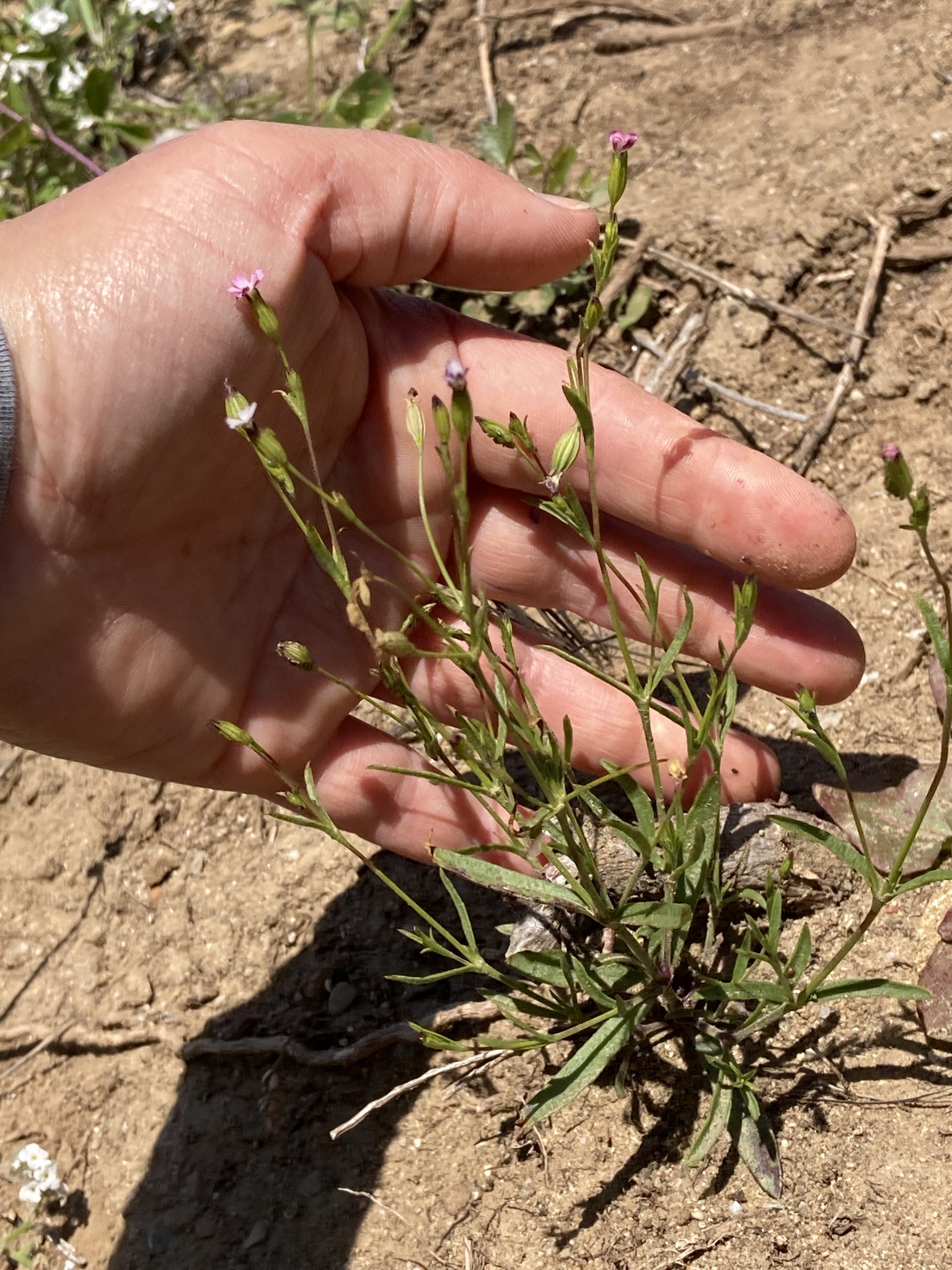
Sleepy Catchfly (Silene antirrhina). The Sleepy Catchfly is very discreet and easy to miss on the trail. It has slender stems, narrow lance-like leaves and grows upright. It has small pink flowers (Mar-Apr) that emerge from an inflated oval calyx (the green leaf-like membranes under the flower). The plant is adapted to many terrains and micro-climate: In San Diego, it can be found from the coast to the mountains and sometimes into the desert. It is native to the Americas and has been introduced to Europe. One of the particularities of the Sleepy Catchfly is that it can, indeed, catch small insects! The stems have darker areas with glandular/sticky trichomes (hair) and insects can get trapped in those. However the plant is not a true carnivorous plant since it does not get any nutrients from the insects. It is what we call protocarnivorous (or paracarnivorous, subcarnivorous or borderline carnivore).
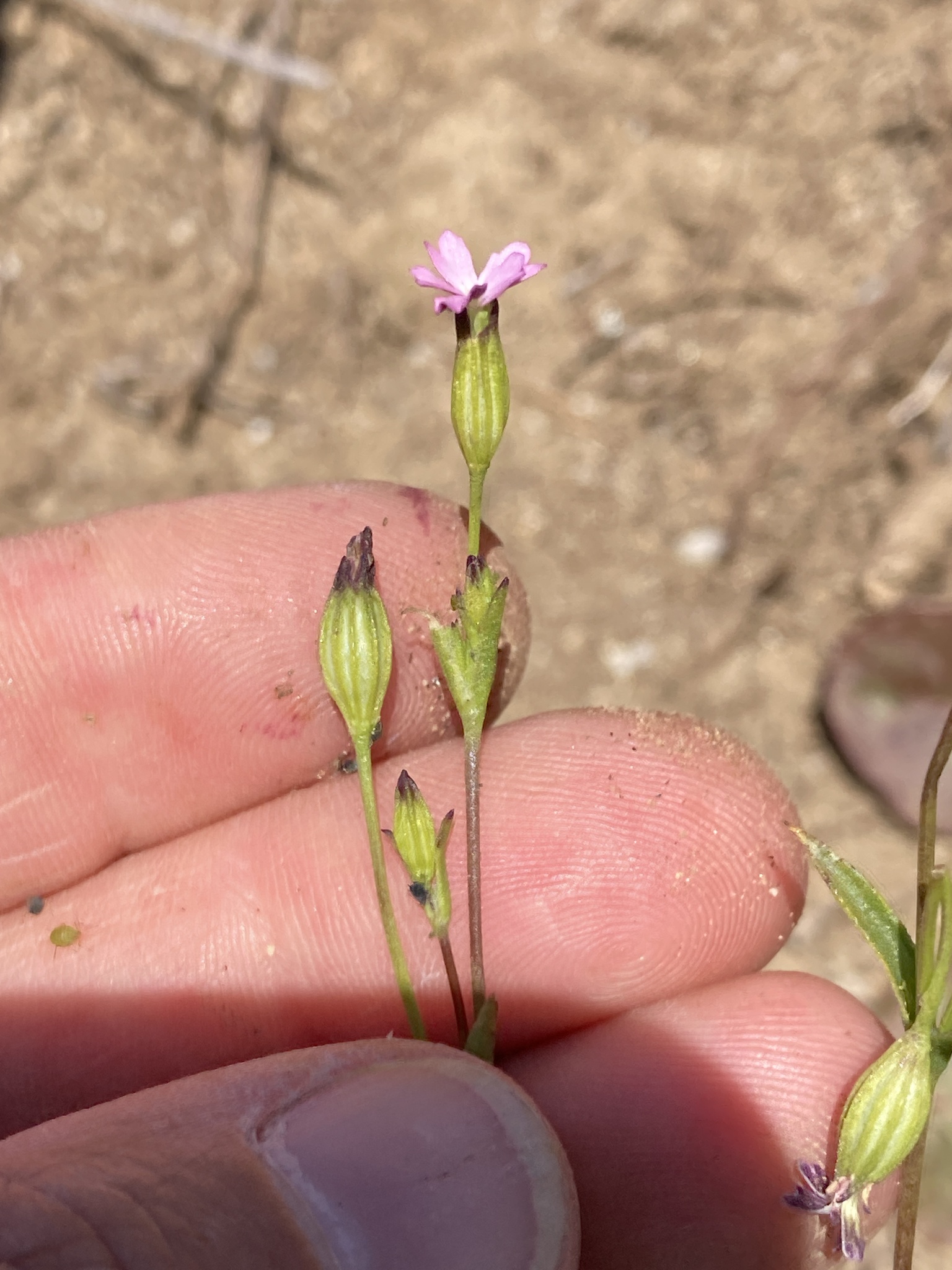
The image shows a close-up of a small plant being held between someone's fingers. The plant has a slender green stem with a few small leaves and buds. At the top of the stem, there is a small pink flower with five petals. The background is a blurred view of the ground, which appears to be dry soil. The person's fingers are slightly dusty, suggesting they might have been working with or examining plants in a dry area.
Sleepy Catchfly (Silene antirrhina); NPS Photo/P. Simpson
The image shows a person's hand gently holding a small plant with thin, green stems and narrow leaves. The plant has tiny pink flowers at the tips of some of the stems. The background is a patch of dry soil with some scattered twigs and a few other small plants visible. The person's hand is positioned to support the plant, and the sunlight casts a shadow on the ground.
Sleepy Catchfly (Silene antirrhina); NPS Photo/P. Simpson


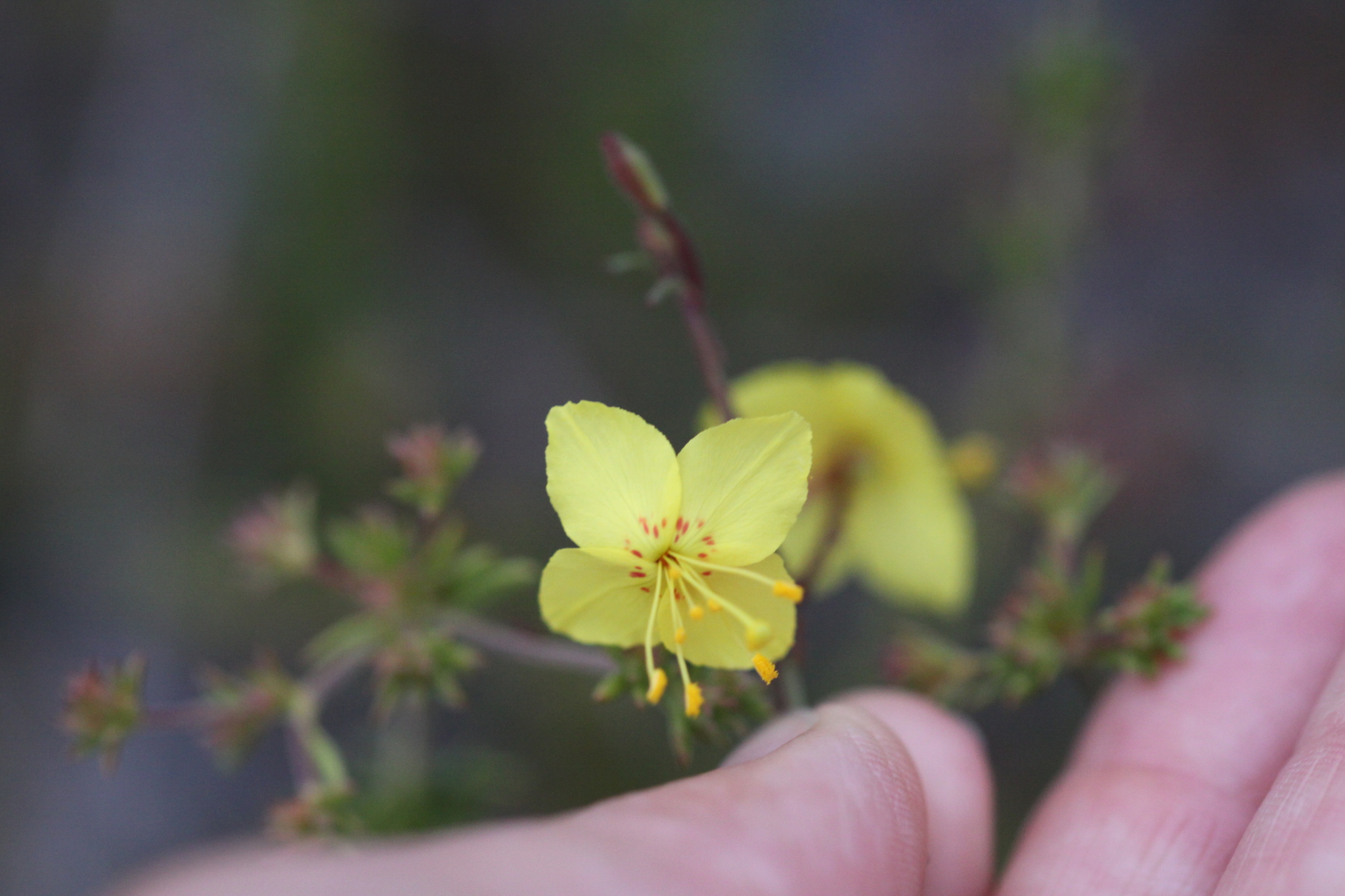
California Suncup (Camissoniopsis bistrota). The California Suncup is in the primerose family. This means flowers have 4 petals! It is native to Southern California and Baja California, Mexico. The plant grows in a prostrate manner, meaning close to the ground. The flowers are larger (a little smaller than a quarter) and bright yellow with red dots on the inside (Mar-May). There is another suncup species down on the Coastal Trail with flowers that look identical: the Beach Suncup (Camissoniopsis cheiranthifolia). The two plants can be told apart from their leaves. The California Suncup has longer lance-like darker green leaves, while the Beach Suncup has light green, oval shaped leaves with a rounded tip.
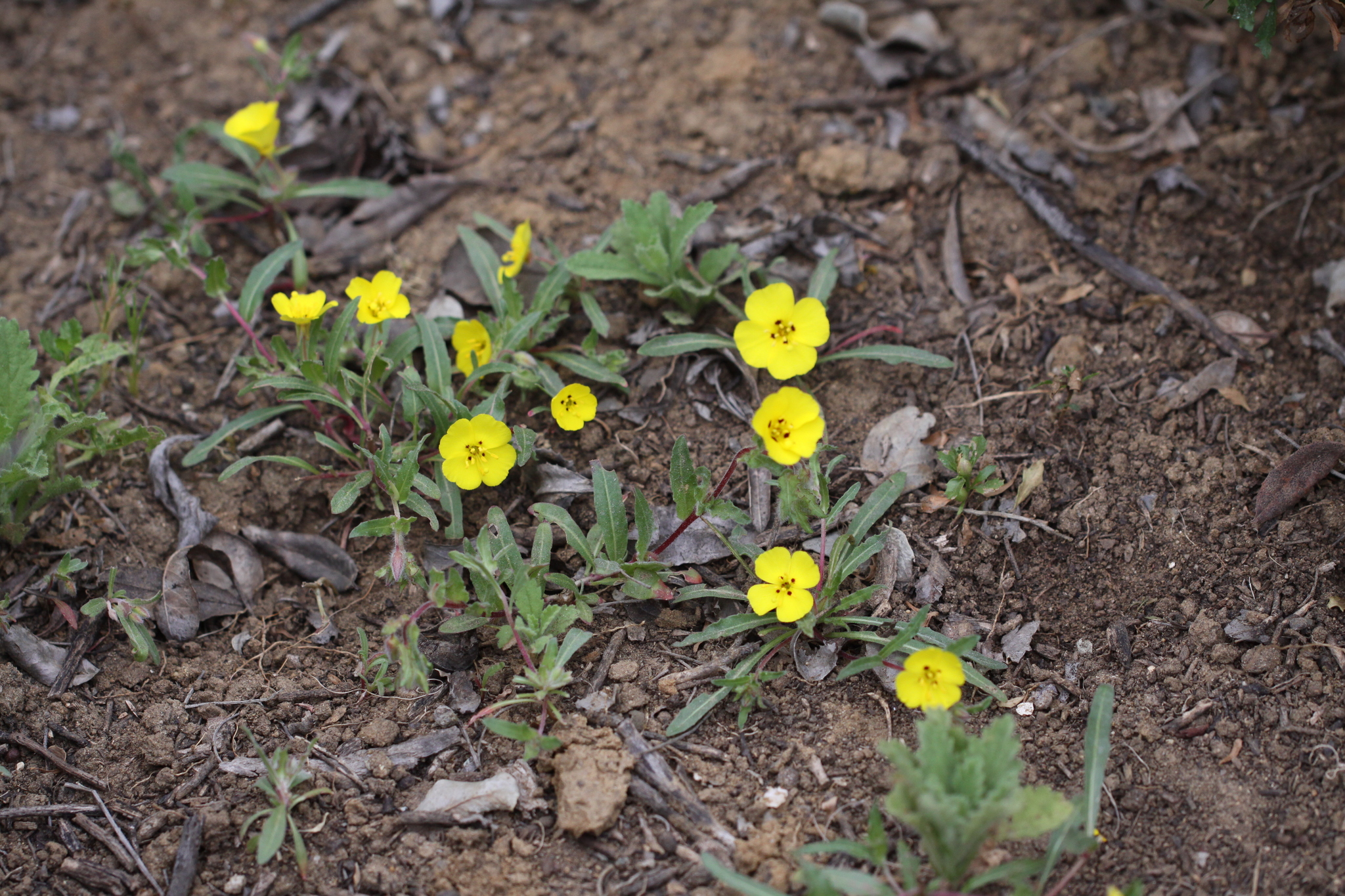
The image shows a patch of ground with small yellow flowers growing among green leaves. The flowers have five petals each and are scattered across the soil, which is mixed with some dry leaves and twigs. The overall scene appears to be a natural, slightly wild area, possibly a garden or a patch of wildflowers.
California Suncup (Camissoniopsis bistrota); NPS Photo/P. Simpson


Clearwater Cryptantha (Cryptantha intermedia). A common umbrella nickname for species in the genus Crythantha and other related plants is Popcorn Flower. But Popcorn Flowers are hard to tell apart. They usually require a picture of the fruit for identification to species. We have two distinct species at the park. The Clearwater Cryptantha or Common Cryptantha is by far the most common and it is abundant on the Oceanside Trail. The other species, Guadalupe Cryptantha (Cryptantha maritima) has very small flowers, barely visible, and can be found off the coastal trail and on slopes south of the Oceanside Trail. The Clearwater Cryptantha grows low to the ground with hairy branching and small clusters of tiny white flowers (Feb-Jun). It is a pollinator favorite due to its long blooming period and abundance of flowers.

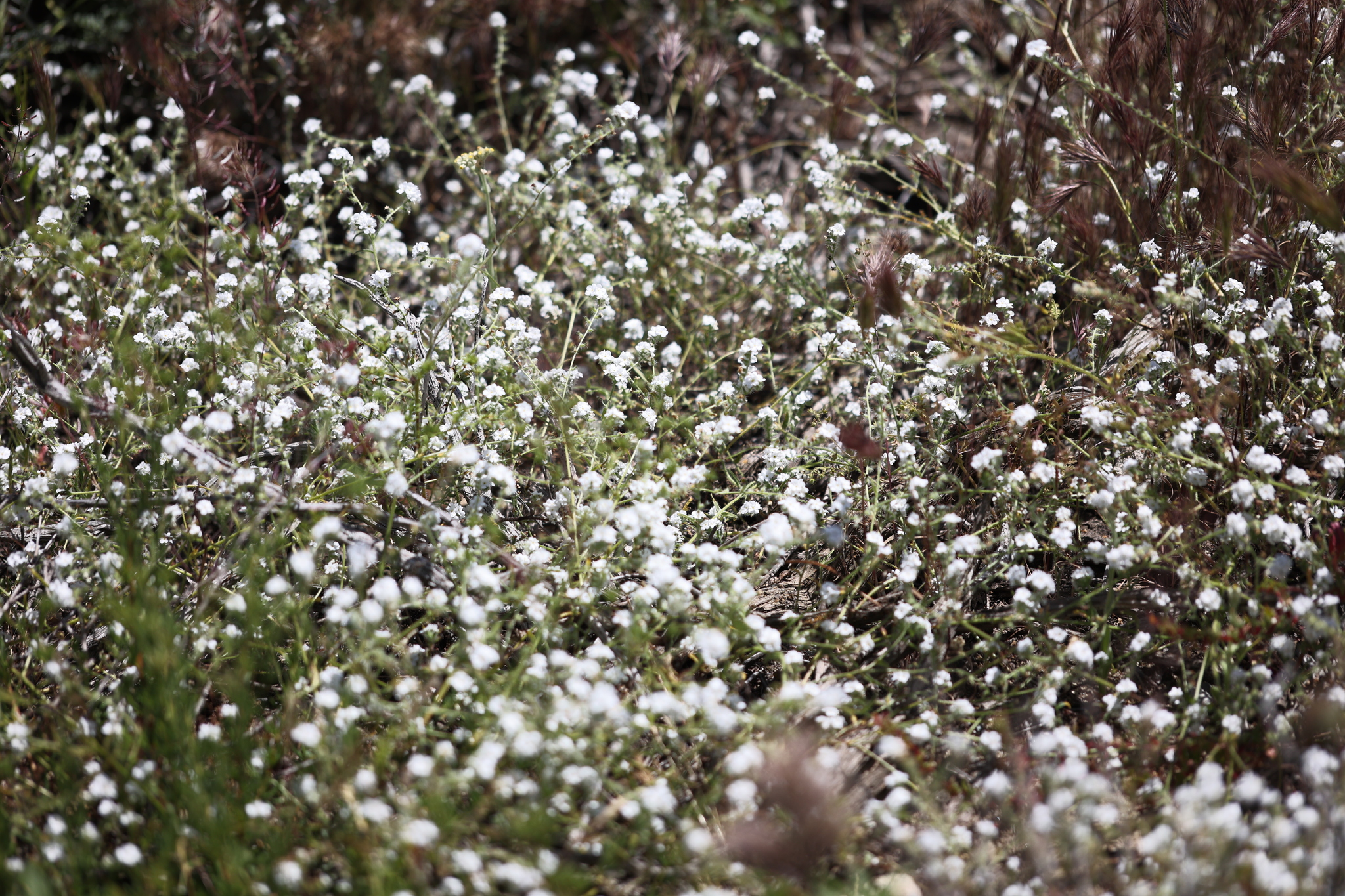
The image shows a close-up of a small cluster of delicate white flowers with tiny yellow centers. The flowers are on a thin, green, and slightly hairy stem. A finger is positioned behind the flowers, likely to provide a sense of scale, indicating that the flowers are quite small. The background is blurred, with shades of green, suggesting that the photo was taken outdoors.
Clearwater Cryptantha (Cryptantha intermedia); NPS Photo/P. Simpson
The image shows a dense patch of small white flowers growing in a natural setting. The flowers are clustered closely together, creating a carpet-like appearance. The background is filled with green stems and leaves, and there are some brownish, dried plants interspersed among the white flowers. The overall scene has a wild, untamed look, typical of a natural meadow or field.
Clearwater Cryptantha (Cryptantha intermedia); NPS Photo/P. Simpson


Small-seed Sandmat (Euphorbia polycarpa). The Small-seed Sandmat is a cousin of our Cliff Spurge and shares some of the same traits, like having cyathiums instead of traditional flowers and oozing white sap when branches or leaves are damaged (please see write-up on Cliff Spurge for more details). But it looks very different. Cliff Spurge is a shrub, but Small-seed Sandmat is a delicate annual or perennial ground cover. It sprouts early on in the winter or sometimes as early as September if monsoonal rains occur. It may be seen all the way through June and sometimes persist in the summer if temperatures remain moderate. However, it is most abundant in the spring (Mar-May), when many plants carpet the landscape. It is an important plant for very small insects. Many use Small-seed Sandmat as a shelter and nectar source. The Kumeyaay use an infusion from this plant to help cure sores, and stings and bites pain. Another name for the plant is Rattlesnake Weed. This name comes from a folk belief that the plant could be used to cure rattlesnake bites.

The image shows a close-up view of a cluster of small flowering plants. The plants have tiny, round leaves that are mostly green with some reddish hues. The flowers are very small, with white petals and a dark red or purple center. The overall appearance is dense, with the plants covering the ground closely. The background appears to be a sandy or rocky surface.
Small-seed Sandmat (Euphorbia polycarpa); NPS Photo/P. Simpson
The image shows a patch of small, ground-covering plants growing in sandy soil. The plants have thin, reddish stems and small, rounded green leaves. Scattered among the leaves are tiny white flowers with a hint of pink or red at their centers. The surrounding area is mostly sandy with some small rocks and dried plant material. The overall appearance is of a hardy plant adapted to a dry, rocky environment.
Small-seed Sandmat (Euphorbia polycarpa); NPS Photo/P. Simpson


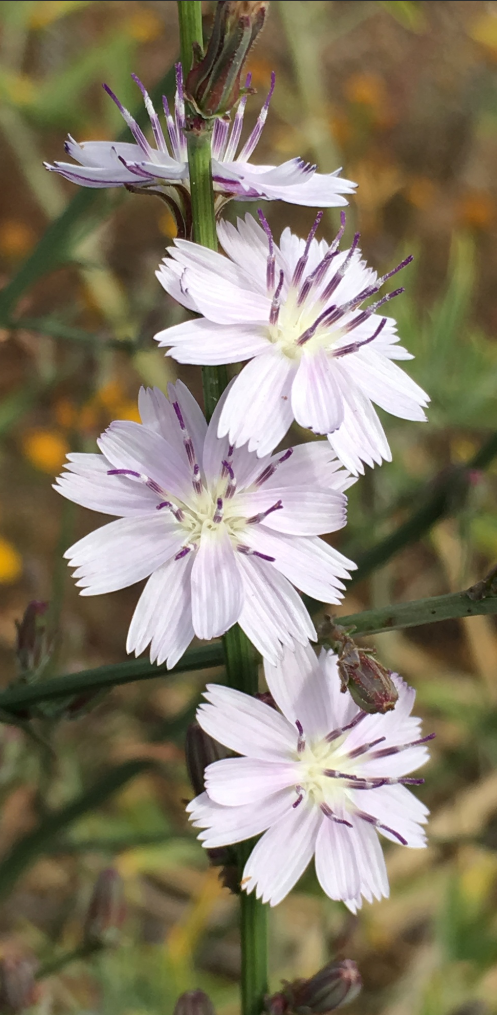
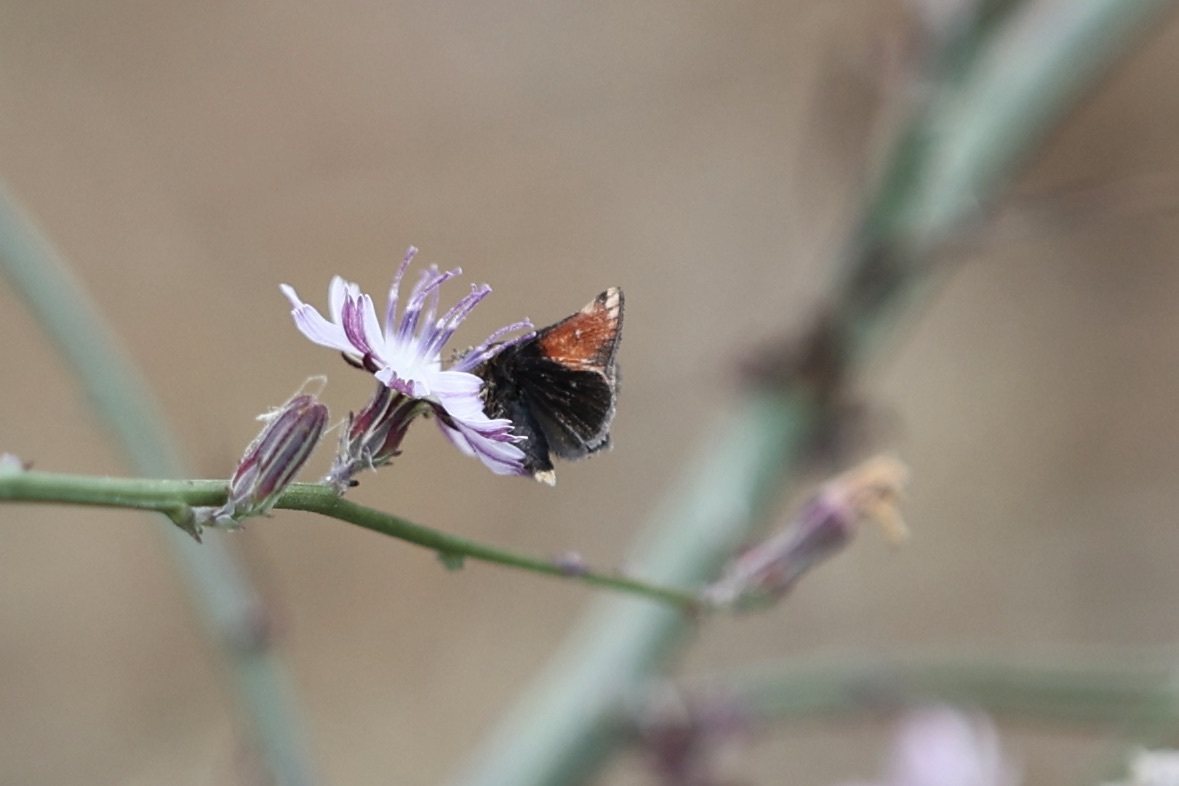
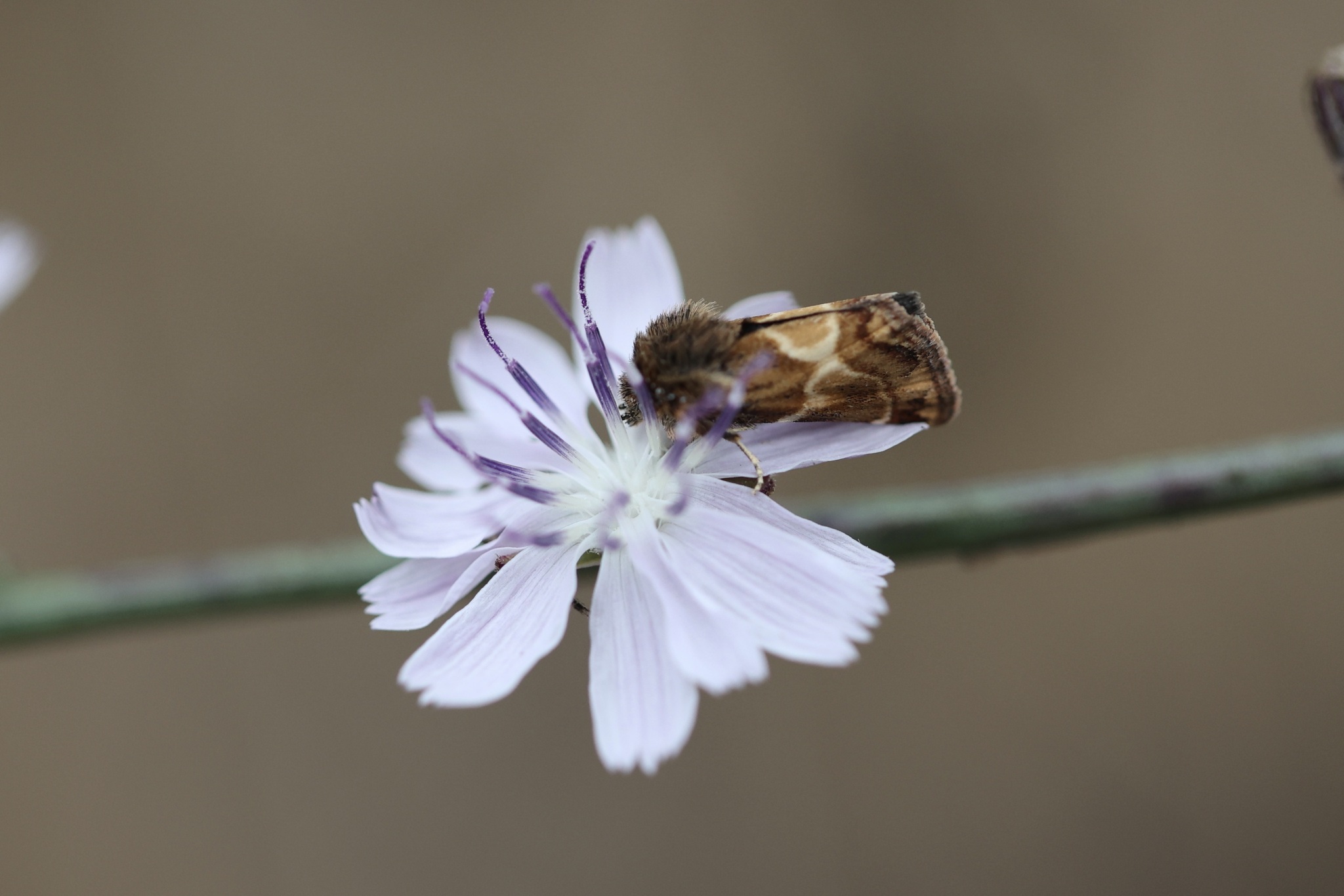
San Diego Wirelettuce (Stephanomeria diegensis). Wirelettuces, also called Twiggy-wreath Plants, are the Ugly Ducklings of the park. They start growing in the spring and look very ‘weedy’. As lettuce do, they start climbing and branching toward the end of the spring. Some plants grow as a small bush, others can tower overhead. When they start to bloom in the summer, they undergo a striking transformation. By that time, most of the leaves have wilted away and the blooms, delicate white to slightly pink flowers, stand alone on the stems, giving the plant a whimsical aspect, like snowflakes suspended in the air. This is one of the most popular plants visitors ask about in the summer and fall. It is also extremely popular with our native pollinators, including a diurnal moth called Schinia scarletina (sorry, no common name, yet). ‘Diurnal’ means the moth is active during the day, when most other moths are sleeping! Here is a common name I’ve made up for this moth: the Scarlet Wirelettuce Moth. Scarlet refers to the bright red underwing, seen when the insect is in flight or after landing. And even though they visit other blooms, they seem particularly fond of the Wirelettuce.
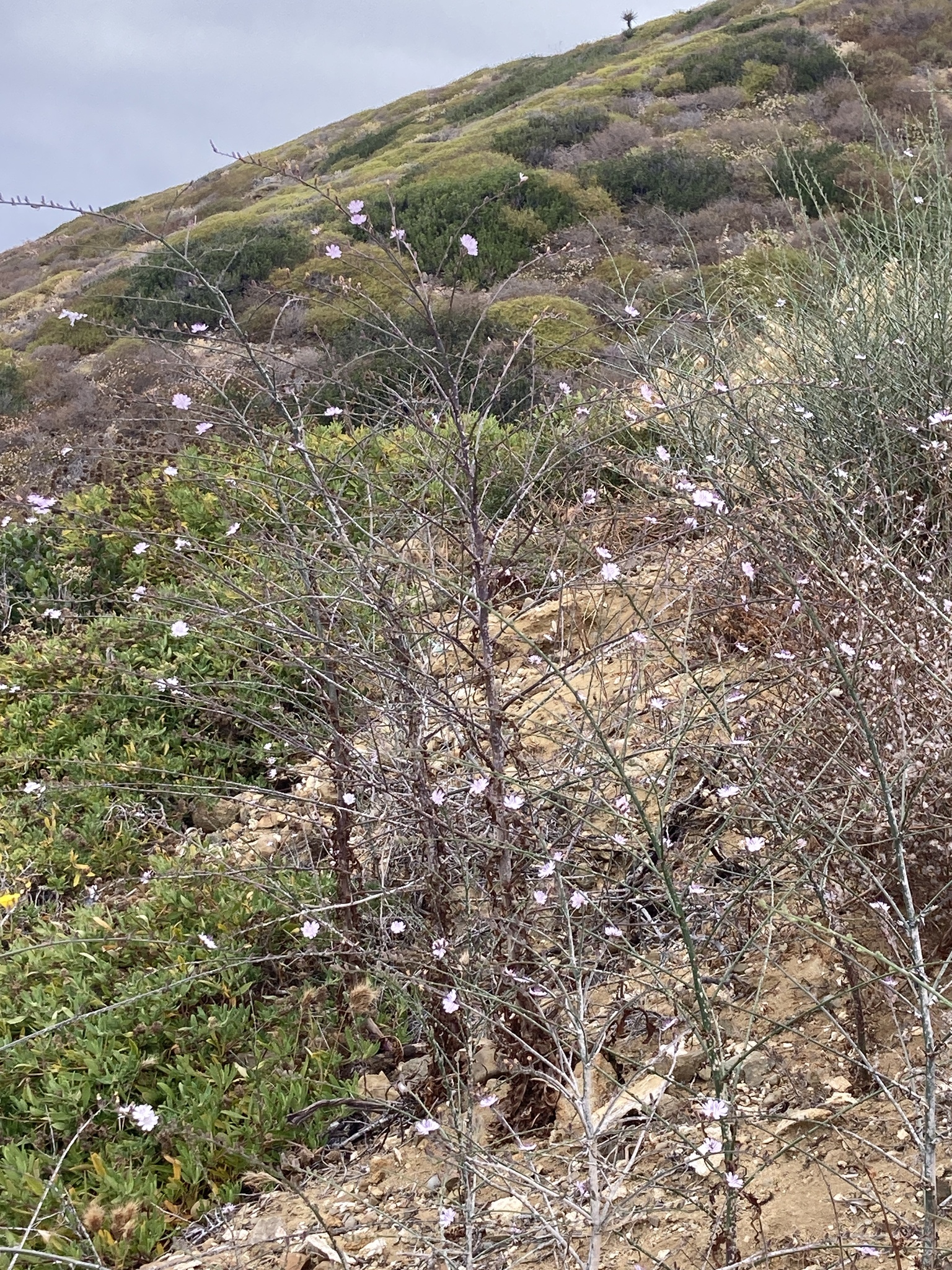
The image shows a hillside covered with various types of vegetation. In the foreground, there is a bush with thin, bare branches that have small, light pink flowers scattered across them. The hillside in the background is covered with patches of green shrubs and plants, with some areas appearing more brown and dry. The sky above is overcast, giving the scene a muted and subdued appearance. The terrain is rocky and uneven, typical of a natural, wild landscape.
San Diego Wirelettuce (Stephanomeria diegensis); NPS Photo/P. Simpson
The image shows a close-up of a small plant growing among gravel and small stones. The plant has thin, elongated leaves that are green with a hint of reddish-purple, especially along the edges and stems. The leaves are somewhat spiky or serrated, giving the plant a slightly prickly appearance. The background consists of a mix of small rocks and patches of soil, with other similar plants visible in the surrounding area. The lighting suggests it is a sunny day.
San Diego Wirelettuce (Stephanomeria diegensis); NPS Photo/P. Simpson
The image shows a close-up of a vertical stem with several delicate, light purple flowers growing along it. Each flower has multiple narrow petals with a slightly fringed appearance, and they are arranged in a circular pattern around a central point. The petals have a subtle gradient, being lighter towards the edges and slightly darker towards the center. The flowers have dark purple stamens protruding from the center. The background is blurred, with hints of green and brown, suggesting a natural outdoor setting.
San Diego Wirelettuce (Stephanomeria diegensis); NPS Photo/P. Simpson
The image shows a small butterfly perched on a delicate flower. The butterfly has dark wings with a hint of orange near the top edges. The flower it is on has thin, elongated petals that are white with a light purple tint. The background is blurred, highlighting the butterfly and flower in the foreground. The flower is attached to a slender green stem, and there are a few unopened buds nearby.
San Diego Wirelettuce (Stephanomeria diegensis); NPS Photo/P. Simpson
The image shows a close-up of a small brown moth perched on a delicate light purple flower. The moth has a patterned brown and tan body with a furry texture. Its wings are folded back, and it is feeding on the flower's center. The flower has thin, elongated petals with a hint of purple at the tips, and the background is a soft, out-of-focus brown, highlighting the moth and flower in the foreground.
San Diego Wirelettuce (Stephanomeria diegensis); NPS Photo/P. Simpson


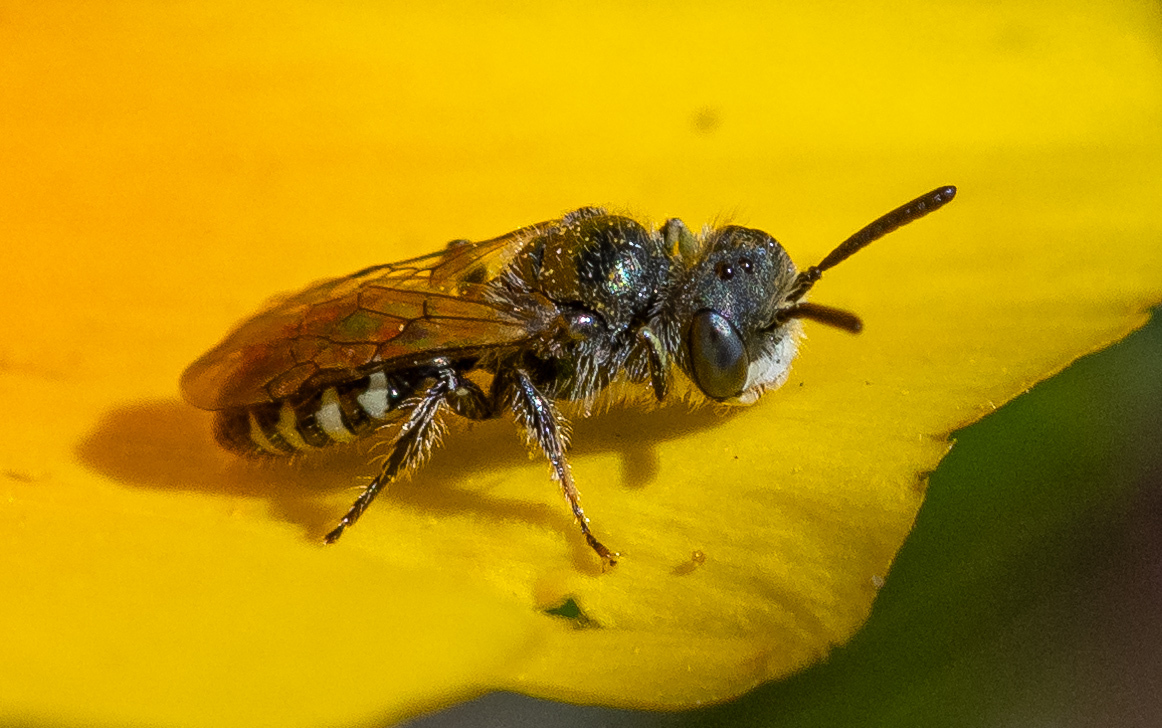
California Poppy (Eschscholzia californica). The California Poppy is one of the most popular flowers in California gardens. It is drought tolerant and the bright orange color is a favorite. In fact, it has been the California State Flower since 1903. Even though they are called California Poppies, they do grow in surrounding states. At Cabrillo NM, poppies can look different depending on where they grow. On the edges of the coastal trail, they are often small and more yellow in color, but most everywhere, they are the common orange color. Flowers are most showy during the day when they open fully. They close during the night. Peak blooming season is April, when the California Poppy Fairy Bee (Perdita interrupta) can be found visiting the flowers. Look closely if you want to find it: this very small bee is just a little bigger that the size of the year on a penny.

The image shows a hillside with a cluster of bright orange poppy flowers in bloom. The flowers are growing amidst green foliage and some dry, brown grass. The soil appears to be dry and sandy. In the background, there is a chain-link fence at the top of the hill, with more greenery and a clear blue sky above. The scene is sunlit, suggesting a bright and clear day.
California Poppy (Eschscholzia californica); NPS Photo/P. Simpson
The image shows a close-up of a small bee resting on a bright yellow flower petal. The bee has a shiny, metallic-looking body with dark eyes and antennae. Its wings are translucent with a slight iridescent sheen, and its legs are covered in tiny hairs. The bee's abdomen has a pattern of alternating dark and light bands. The yellow petal provides a vibrant background that contrasts with the bee's darker colors.
California Poppy Fairy Bee (Perdita interrupta); Photo credit: Craig Chaddock

Miniature Lupine (Lupinus bicolor) and Collared Annual Lupine (Lupinus truncatus). We have three different species of Lupines in the park and two of them can be found on the Oceanside Trail, in the coastal zone. Leaves of both plants are palmate (A), meaning they look like spread out fingers on a hand. Typical of plants in the Legume family (Fabaceae), flowers are “lipped”: they have one upper petal (or two fused petals), called the banner and 3 lower petals (the keel in the center and the wings on either side). Our two species of lupines can easily be told apart by their size and flower colors. The Miniature Lupine is bluish-purple with a white and blue banner (B). Hence the Latin name: bicolor. The plant is also small in size (<2ft tall). In contrast, the Collared Annual Lupine is most often magenta-purple (C), with some of the older flowers turning a deeper purple color (D). The banner, keel and wings are fairly uniform in color and the plant is larger in size (>3ft tall). Both species bloom at about the same time, between March and May.
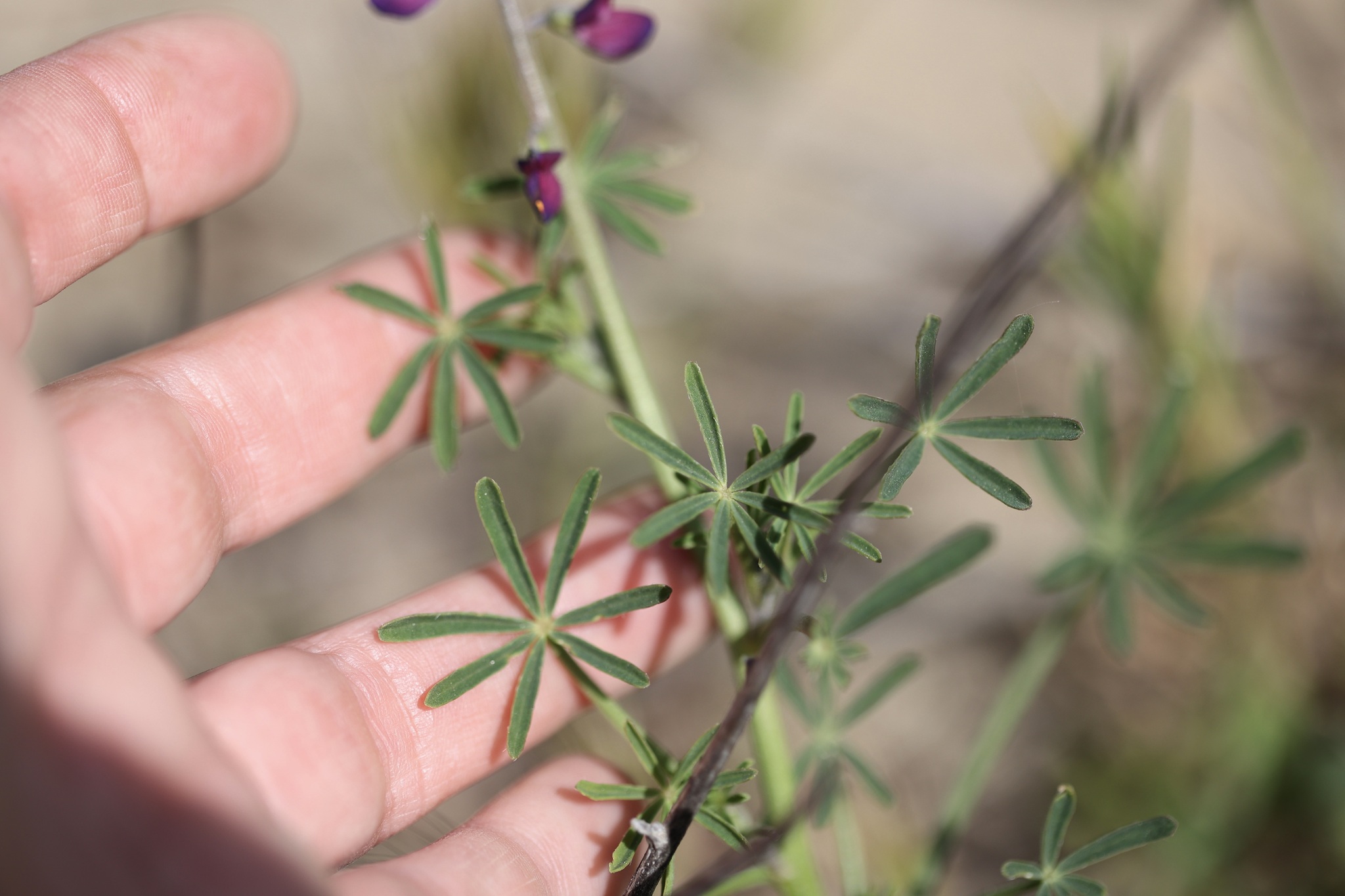
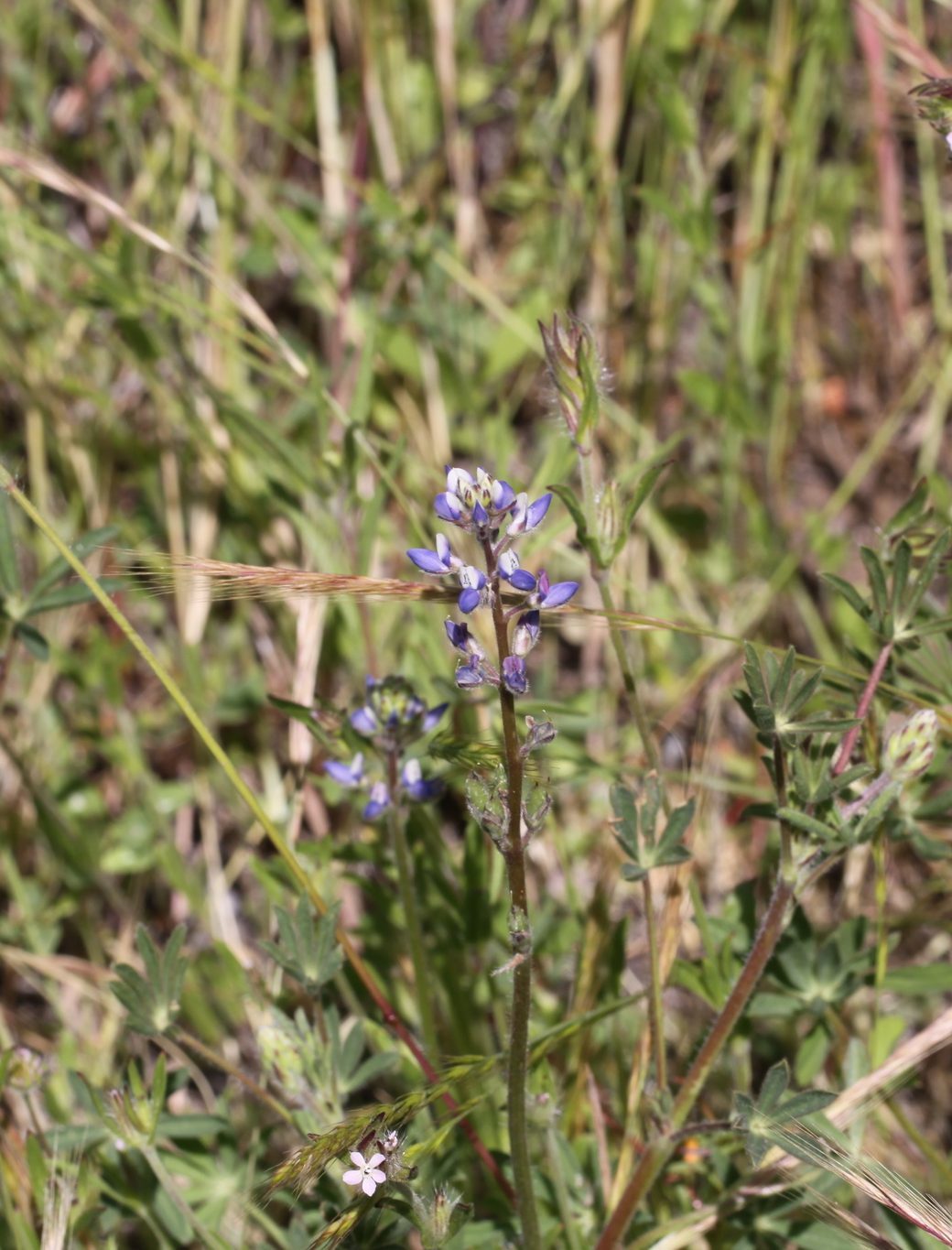
The image shows a close-up of a person's hand gently holding a plant. The plant has slender, elongated green leaves arranged in a radial pattern, resembling a star or a wheel. In the background, there are small purple flowers on the plant's stem. The focus is primarily on the leaves and the hand, with a blurred background. The lighting is natural, suggesting the photo was taken outdoors.
(A)-Miniature Lupine (Lupinus bicolor); NPS Photo/P. Simpson

The image shows a close-up of a patch of wild vegetation. In the center, there is a plant with small purple flowers, each flower having multiple petals. The plant is surrounded by various grasses and green leaves. The background is a mix of green and brown, indicating a natural, possibly dry, grassy area. The sunlight is bright, casting clear shadows and highlighting the textures of the leaves and flowers.
(B)-Miniature Lupine (Lupinus bicolor); NPS Photo/P. Simpson

The image shows a close-up of a purple flower, possibly a type of lupine, with small, delicate petals. The flower is covered in droplets of water, suggesting it has recently rained or there is morning dew. The background is filled with green leaves, which are also dotted with water droplets, creating a fresh and vibrant scene. The focus is on the flower, making the background slightly blurred.
(C)-Collared Annual Lupine (Lupinus truncatus); NPS Photo/P. Simpson
The image shows a close-up of a tall, slender plant with small, vibrant purple flowers growing along its stem. The flowers are arranged in clusters, with some appearing to be a deeper shade of purple or pink. The background is blurred, consisting of green and brown tones, suggesting a natural, outdoor setting. There are also some thin, dry branches visible in the background.
(D)-Collared Annual Lupine (Lupinus truncatus); NPS Photo/P. Simpson


Clustered Tarweed (Deinandra fasciculata). Clustered Tarweed is an important plant in the park. It is a late blooming annual (May-Aug) that attracts many pollinators. One of them, the Pomona Longhorn (Tetraloniella pomonae) will only visit Clustered Tarweed. During drought years, when hardly any Tarweed is seen, the bee is absent. We know little about the clues these bees use to emerge on years when there is sufficient number of their favorite plant available. Tarweed also generally performs well in disturbed areas. This means it is a good native plant to fight other non-native invasives that might want to take up residence in bare patches. Clustered Tarweed also has sticky leaves and the Kumeyaay would gather a bunch and use them as a whiskbroom to clean up the fruit of the Prickly Pear cactus (tunas). There is a look alike plant in the park: Golden Yarrow. However, Golden Yarrow flower heads are entirely yellow, whereas Tarweed has dark brown to black stamens visible in the disk flowers (the tiny flowers at center of “the flower”). Golden Yarrow also blooms earlier than Tarweed (Mar-Jun).
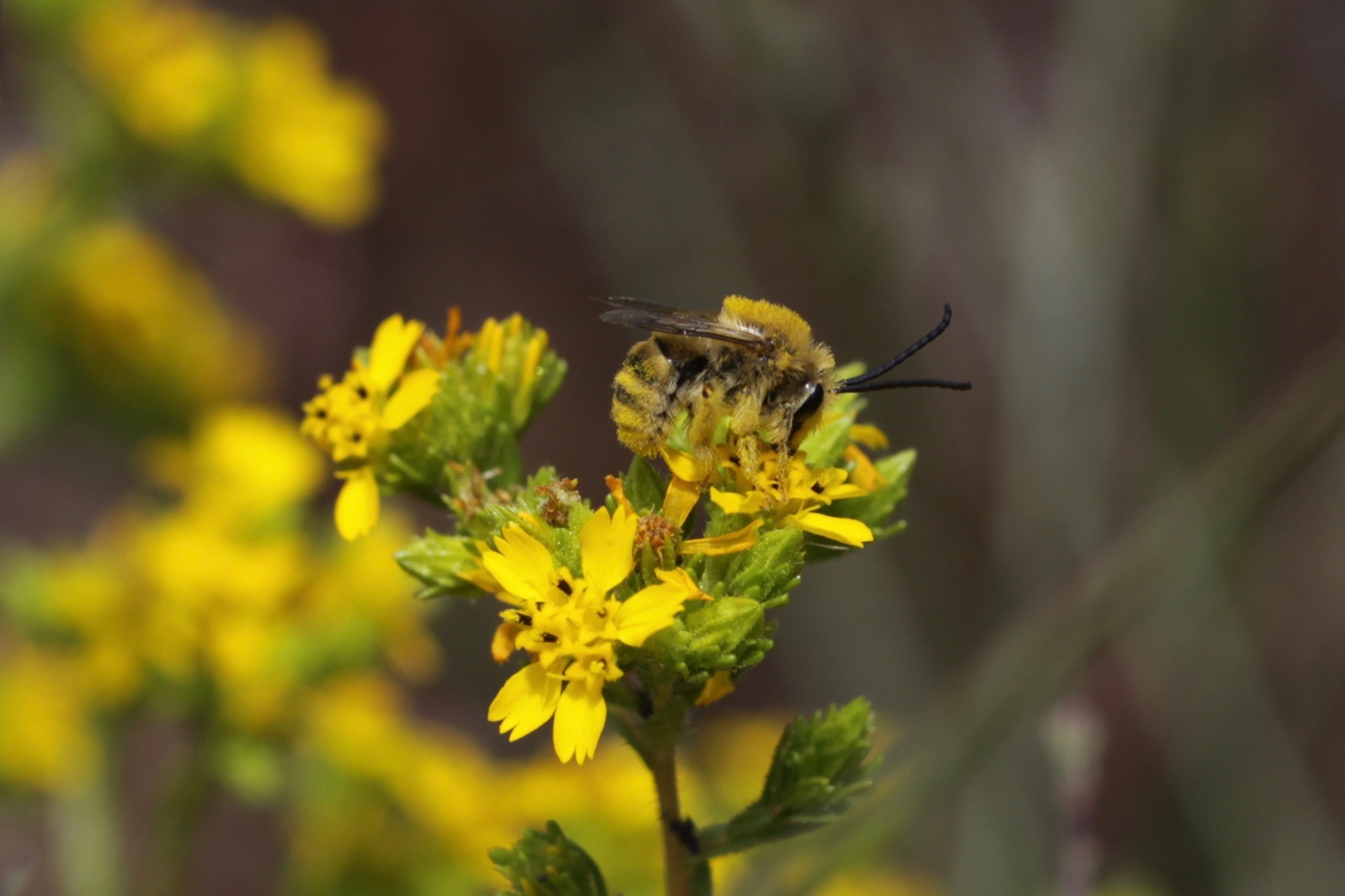
The image shows a close-up view of a cluster of small, bright yellow flowers. The flowers have multiple petals and are densely packed together, creating a vibrant and lively appearance. The background is slightly blurred, emphasizing the flowers in the foreground. The flowers are likely part of a bush or shrub, with green stems and leaves visible among the blossoms.
Pomona Longhorn (Tetraloniella pomonae) on Clustered Tarweed; NPS Photo/P. Simpson
The image shows a dense cluster of small yellow flowers growing in a natural setting. The flowers have multiple petals and are spread across thin, green stems with small leaves. The background consists of dry grass and soil, suggesting a dry or arid environment. The flowers are vibrant and stand out against the more muted tones of the surrounding vegetation.
Clustered Tarweed (Deinandra fasciculata)NPS Photo/P. Simpson


San Diego Wild Cabbage or San Diego Jewelflower (Caulanthus hetetophyllus). The San Diego Wild Cabbage is one of those wildflowers that are easy to miss. Although it grows to a fairly good size (>20 inches tall), it is a slender weedy-looking plant with relatively small flowers. But for those who take the time to observe the blooms (Mar-Apr), it is well worth it. The top of the plant is adorned with small trumpet-shaped magenta flowers. The pointy leaves are much larger at the bottom of the plant and get smaller up along the stem. The San Diego Wild Cabbage is found in San Diego of course, but also south into Baja, California and north up to Santa Barbara. It is fairly common from the coast to the mountains, but doesn’t grow in desert areas.

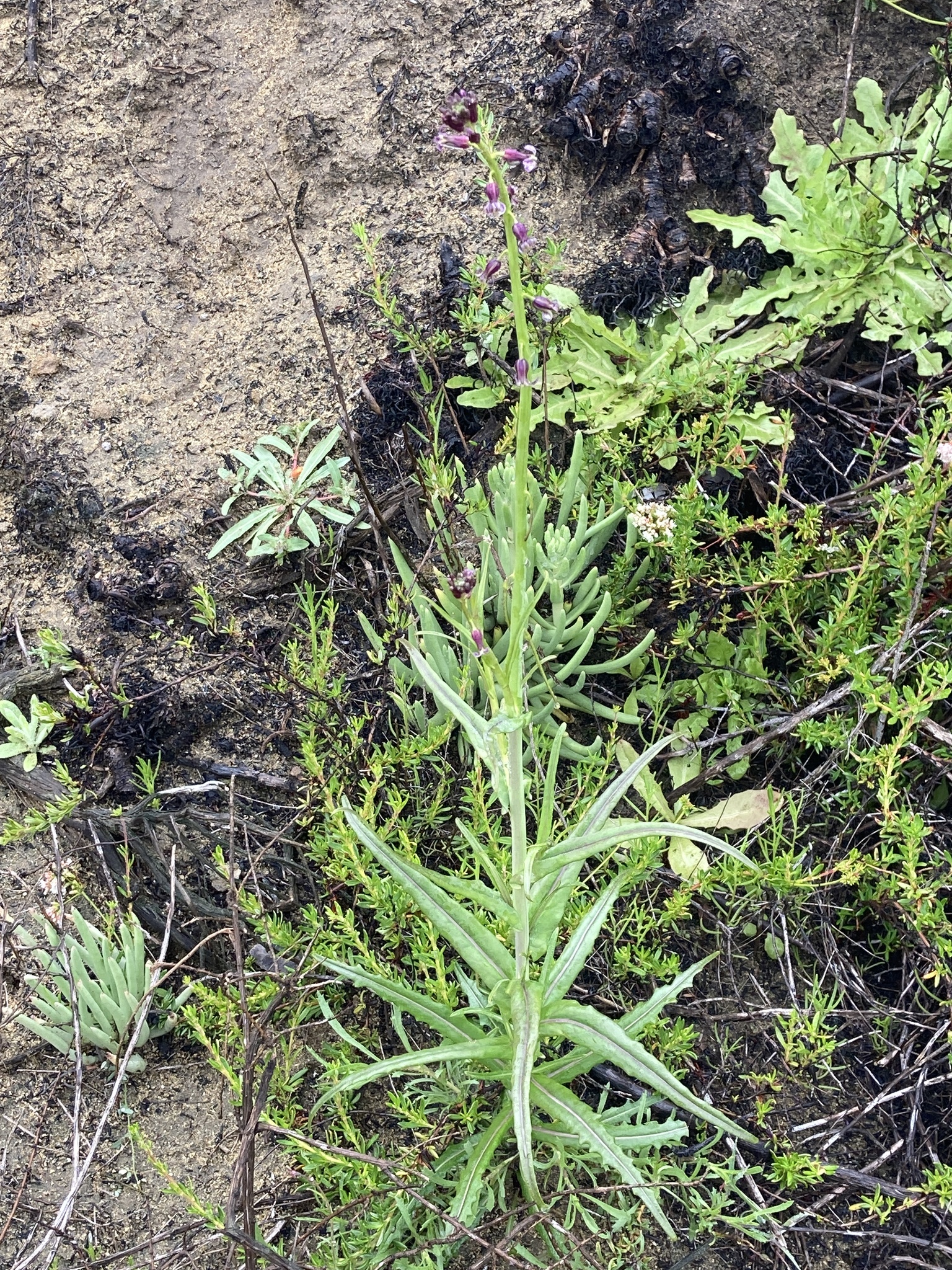
The image shows a close-up of a plant with a tall, slender green stem. Along the stem, there are small, tubular flowers that are a deep purple color. The flowers are arranged in a vertical line, and each has a few delicate, curled petals. The plant is covered in small water droplets, suggesting it has recently rained or there is morning dew. The background is blurred, showing a natural setting with green foliage and a hint of a dirt or rocky surface.
San Diego Wild Cabbage or San Diego Jewelflower (Caulanthus hetetophyllus); NPS Photo/P. Simpson
The image shows a patch of ground with various plants growing. In the center, there is a tall, slender plant with long, narrow green leaves and small purple flowers at the top. The flowers are clustered together on a stem. Surrounding this plant are other types of vegetation, including some low-growing green plants with small leaves. The ground appears to be a mix of soil and small rocks, with some darker patches that might be damp or burnt areas. The overall setting looks like a natural, possibly wild area.
San Diego Wild Cabbage or San Diego Jewelflower (Caulanthus hetetophyllus); NPS Photo/P. Simpson

Fringed Spineflower (Chorizanthe fimbriata). Fringed Spineflowers are one of the most beautiful flowers in the park. In average rain years in late spring (Apr-Jun), they provide pink carpeting to many bare spots on our south facing slopes. Believe it or not, it is a cousin to our California Buckwheat, being in the same family (Polygonaceae aka: Buckwheats). Fringed Spineflowers are named after their, you guessed it, fringed flowers.

The image shows a patch of dry, rocky soil with small, delicate plants growing in it. The plants have thin, green stems and are topped with clusters of tiny, star-shaped pink flowers. The ground is covered with small rocks and pebbles, and there are some dry twigs scattered around. The overall scene suggests a dry, possibly arid environment where these resilient plants are thriving despite the harsh conditions.
Fringed Spineflower (Chorizanthe fimbriata); NPS Photo/P. Simpson
The image shows a close-up of a delicate plant with small, feathery pink flowers. The flowers are clustered together on thin, reddish stems. The background is blurred, with muted earthy tones, which helps the vibrant pink flowers stand out prominently in the foreground. The overall appearance is soft and intricate, highlighting the fine details of the flower petals.
Fringed Spineflower (Chorizanthe fimbriata); NPS Photo/P. Simpson

California Primrose (Eulobus californicus). The California Primrose is sometimes called California Suncup. This common name can lead to confusion because it is also the common name for Camissoniopsis bistrota (see above) and both plants are fairly common in the park. So let’s stick to California Primrose! The plant first emerges in the early winter as a rosette of leaves on the ground. The leaves are serrated and have brown to black specks on the upper side. In early spring, long stems, up to four or five feet long, shoot up. The leaves of the stems are similar to the basal rosette leaves, except smaller and more slender. As all flowers in the primrose family, California Primrose have four petals (Feb-Apr). The flowers are yellow and sometime have some orange dots at the center.

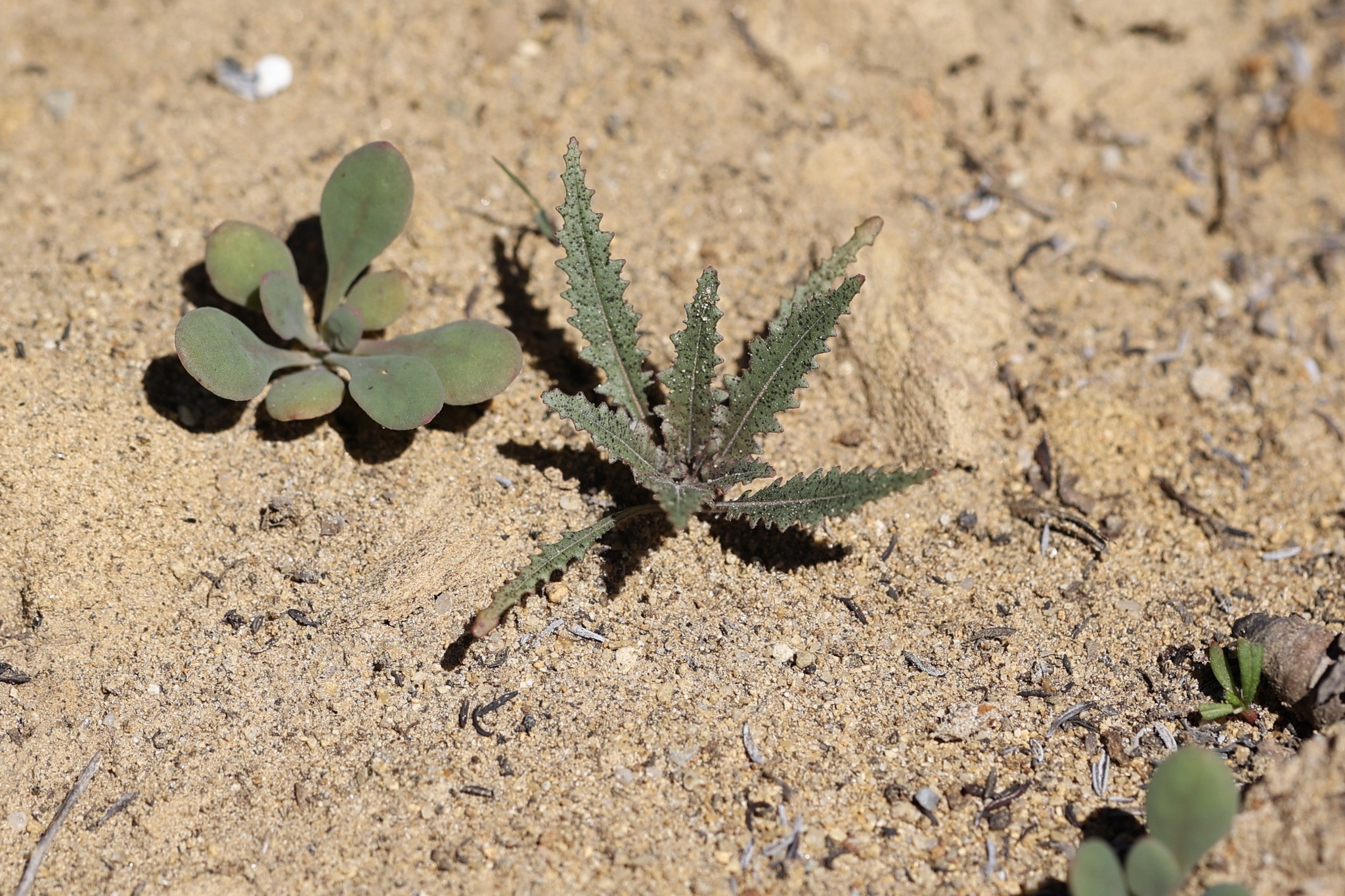
The image shows a small plant growing out of a sandy or rocky surface. The plant has a central stem that is reddish in color and extends upwards with several thin branches. The leaves are green, narrow, and have a serrated or spiky edge, radiating out from the base of the plant. The background consists of a rough, sandy or rocky texture, with a shadow cast by the plant onto the surface. There is also a small, dark hole in the rock or sand near the plant. The lighting is bright, suggesting it is taken in daylight.
California Primrose (Eulobus californicus); NPS Photo/P. Simpson
The image shows two small plants growing in sandy soil. The plant on the left has broad, rounded leaves with a smooth texture and a slight reddish tint on the edges. The plant on the right has long, narrow leaves with serrated edges, resembling a dandelion leaf. The sandy soil is light brown and has small pebbles and organic debris scattered around. The lighting suggests a sunny day, casting shadows from the plants onto the sand.
California Primrose (Eulobus californicus); NPS Photo/P. Simpson
The image shows a close-up of a small yellow flower with five petals. The petals have a few red markings near the center. The flower has several long, thin stamens with yellow tips extending from its center. A hand is gently holding the stem of the flower, and there is another similar flower slightly out of focus in the background. The background is blurred, highlighting the flower and the hand.
California Primrose (Eulobus californicus); NPS Photo/P. Simpson

PERENNIALS
Blue Dicks/Wild Hyacinth (Dipterostemon capitatus). Blue Dicks, also called Wild Hyacinth (for the immature crowds who can’t handle the first option), is an herbaceous perennial. It grows from an underground corm. A corm is similar to a bulb, except bulbs (like onions and ogres) have layers, while corms are solid. When blue dicks first sprout, long leaves may appear. They are usually sort of limp and stay close to the ground, despite being long. The plant then sends a single straight-up stem, which will be topped by a purple inflorescence called a head. The head may have anywhere from 2 to 15 flowers and may reach two feet in height. Blue Dicks can reproduce by seeds or cormlets. Cormlets are small corms that develop along side the main corm. Blue Dicks were an important food source for Native Americans. The corms could be dug up and roasted. Another name for the corm is “Indian Potato”.

The image shows a small patch of sandy and rocky ground with sparse vegetation. In the foreground, there are two delicate purple flowers on thin stems, standing out against the earthy background. The ground is a mix of sand, small rocks, and some larger stones, with patches of green plants scattered around. In the background, there is more greenery, including some bushes and a path leading away from the scene. The overall setting appears to be a natural, possibly arid or semi-arid environment.
Blue Dicks/Wild Hyacinth (Dipterostemon capitatus); NPS Photo/P. Simpson
The image shows a close-up of a hand holding a small cluster of delicate, light purple flowers. The flowers have a star-like shape with six petals each, and they are grouped together on a single stem. The background is slightly blurred, showing a natural setting with some greenery and earthy tones, suggesting the flowers are outdoors in a garden or natural area. The hand holding the flowers is positioned in the lower left part of the image.
Blue Dicks/Wild Hyacinth (Dipterostemon capitatus); NPS Photo/P. Simpson


Weed’s Mariposa Lily (Calochortus weedii). One of the most showy flowers we have in the park. The beautiful yellow flowers bloom later in the spring to early summer (peak: June). They attract many native bees since the large long anthers produce a lot of pollen when most other spring flowers have already died off. They are great in gardens because they are bulbs and will grow back every year. They are native to southern California where they are considered “vulnerable”. They also occur in Baja California where they are listed as “critically imperiled”.

The image shows a close-up of a single yellow flower with delicate, fringed petals and a central cluster of stamens. The flower is on a slender green stem, with a small, unopened bud visible below it. The background is blurred, consisting of muted brown and beige tones, suggesting a natural, possibly dry or grassy environment. The focus is primarily on the flower, making it stand out against the soft background.
Weed’s Mariposa Lily (Calochortus weedii); NPS Photo/P. Simpson

Wishbone Bush (Mirabilis laevis). Wishbone Bush is a perennial, low-growing plant with delicate purple flowers (Feb-Apr). It dies down to the grown during the hotter months (sometimes a skeletal ghost of a plant remains) and resprouts after first rains. Wishbone Bush gets its name from the configurations of the leaves on the stems. A stem forks in two, with two basal leaves, forming a Y-shape, or wishbone.

The image shows a close-up view of a cluster of small, vibrant purple flowers growing in a natural setting. The flowers have multiple petals and yellow centers. They are surrounded by green leaves and stems, which are slightly fuzzy. The background is filled with more of these flowers and some greenery, suggesting a field or meadow. The sky above is overcast, providing a soft light over the scene.
Wishbone Bush (Mirabilis laevis); NPS Photo/P. Simpson

California Aster (Corethrogyne filaginifolia). Also called Common Sandaster, the California Aster has bright to pale pink petal (ray flowers) and a yellow center (disk flowers). It is in the Sunflower family and is what we call a “composite”. What we typically think of as a single flower is in fact many flowers, also called a head. Each so-called ‘petal’ is indeed a single flower, called a ray flower. And the yellow center is composed of many individual flowers. As such, a single ‘head’ provides lots of opportunities for pollinators to forage. The California Aster blooms from later in the spring and through the summer. The blooms sometimes persist into the fall. It is a great food source for many of our bees and other insects during the hottest months of the year, when blooms are rarer.
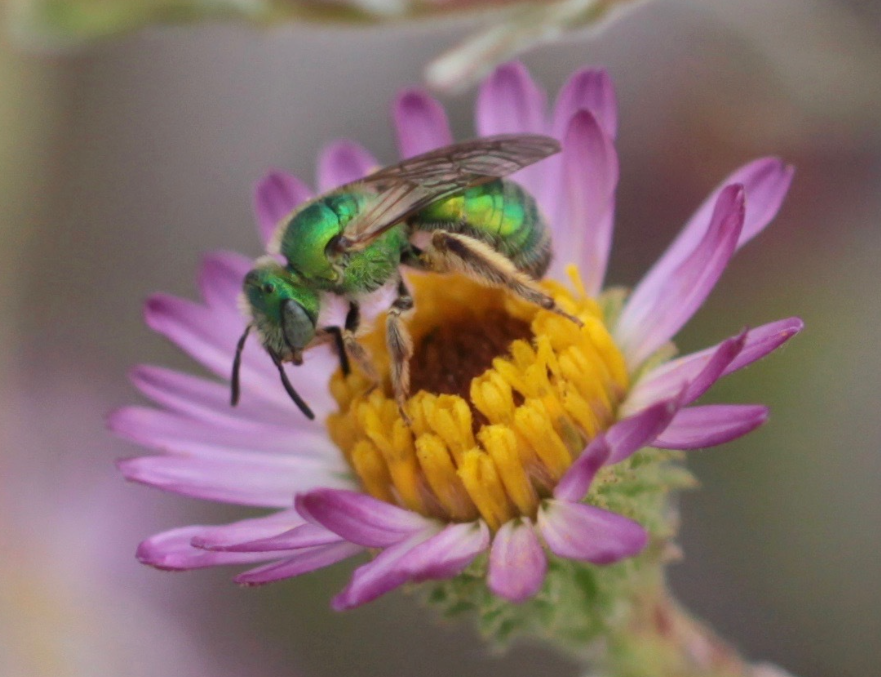
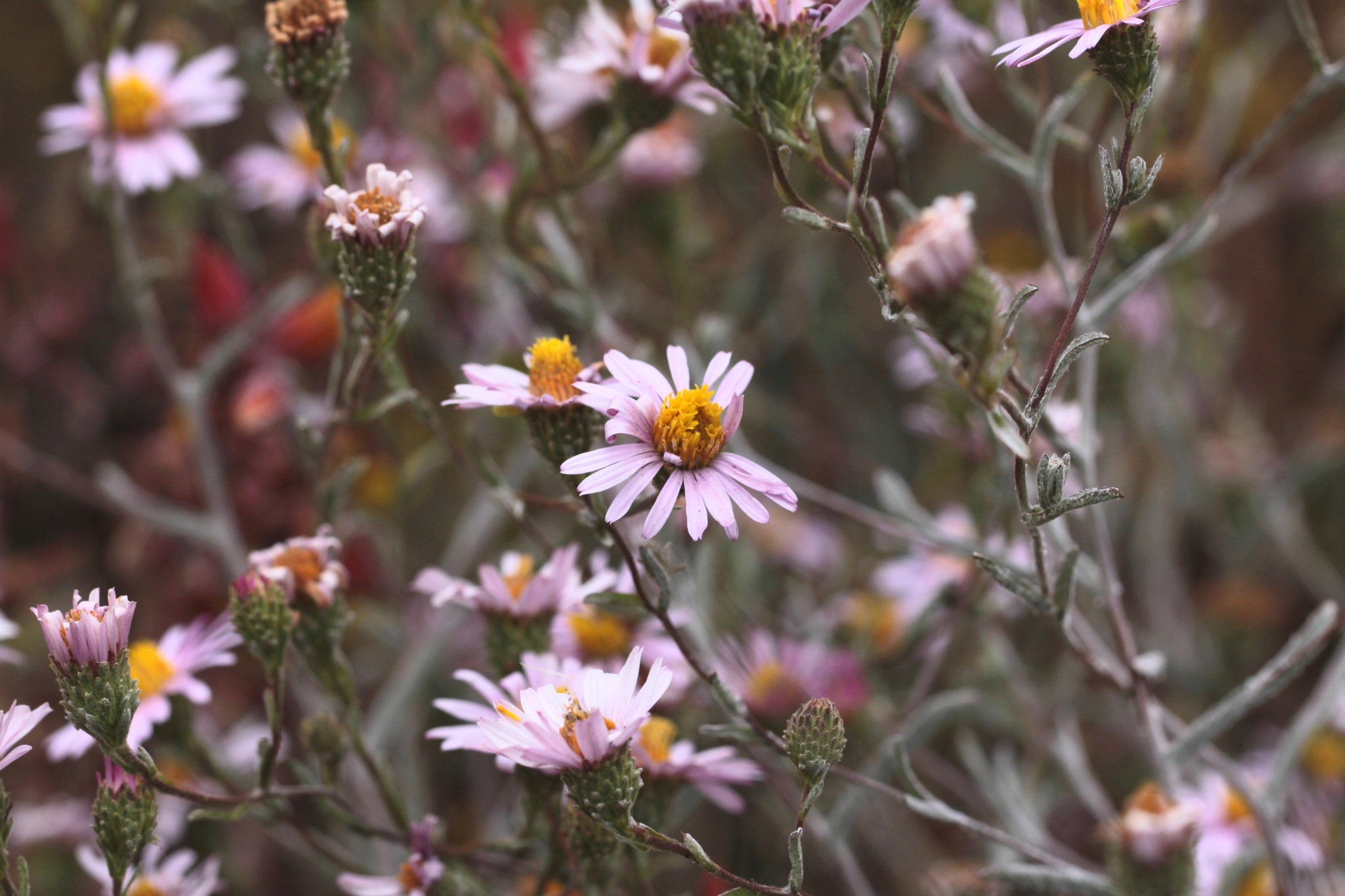
The image shows a close-up of a vibrant green bee perched on a flower. The bee has a metallic green body and is collecting nectar from the flower's center. The flower has a yellow center surrounded by delicate, light purple petals. The background is softly blurred, highlighting the bee and the flower as the main focus of the image.
Texas Striped-Sweat Bee (Agapostemon texanus) on California Aster; NPS Photo/P. Simpson
The image shows a close-up of a cluster of wildflowers. The flowers have light pink petals with bright yellow centers. They are growing on thin, green stems with small leaves. Some of the flowers are fully bloomed, while others are still in the budding stage. The background is a blur of similar flowers and stems, giving a natural and slightly wild appearance.
California Aster (Corethrogyne filaginifolia); NPS Photo/P. Simpson


Wooly Indian Paintbrush (Castilleja foliolosa). This plant is most striking when in bloom (peak March/May, but can persist through the summer). The orange/red inflorescence doesn’t look like typical flowers, but more so like colored leaves, giving the plant the look of its namesake: a paintbrush. Though it may not look like it, the Wooly Indian Paintbrush is a parasitic plant. All the sucking out of the nutrients from other plants happens underground, through its roots! That’s what we call a root-parasitic plant. At the Cabrillo Greenhouse, we have to sow Indian Paintbrush seeds with a woody shrub, in order for it to grow. We usually sow it along with California Buckwheat or California Sagebrush seeds. The paired shrubs don’t appear to struggle from being associated with or used by the paintbrush. On the Oceanside Trail, as well as on the Bayside Trail, you may once in a while run into a yellow Indian Paintbrush. It’s a rarer color morph, but we love them just the same.
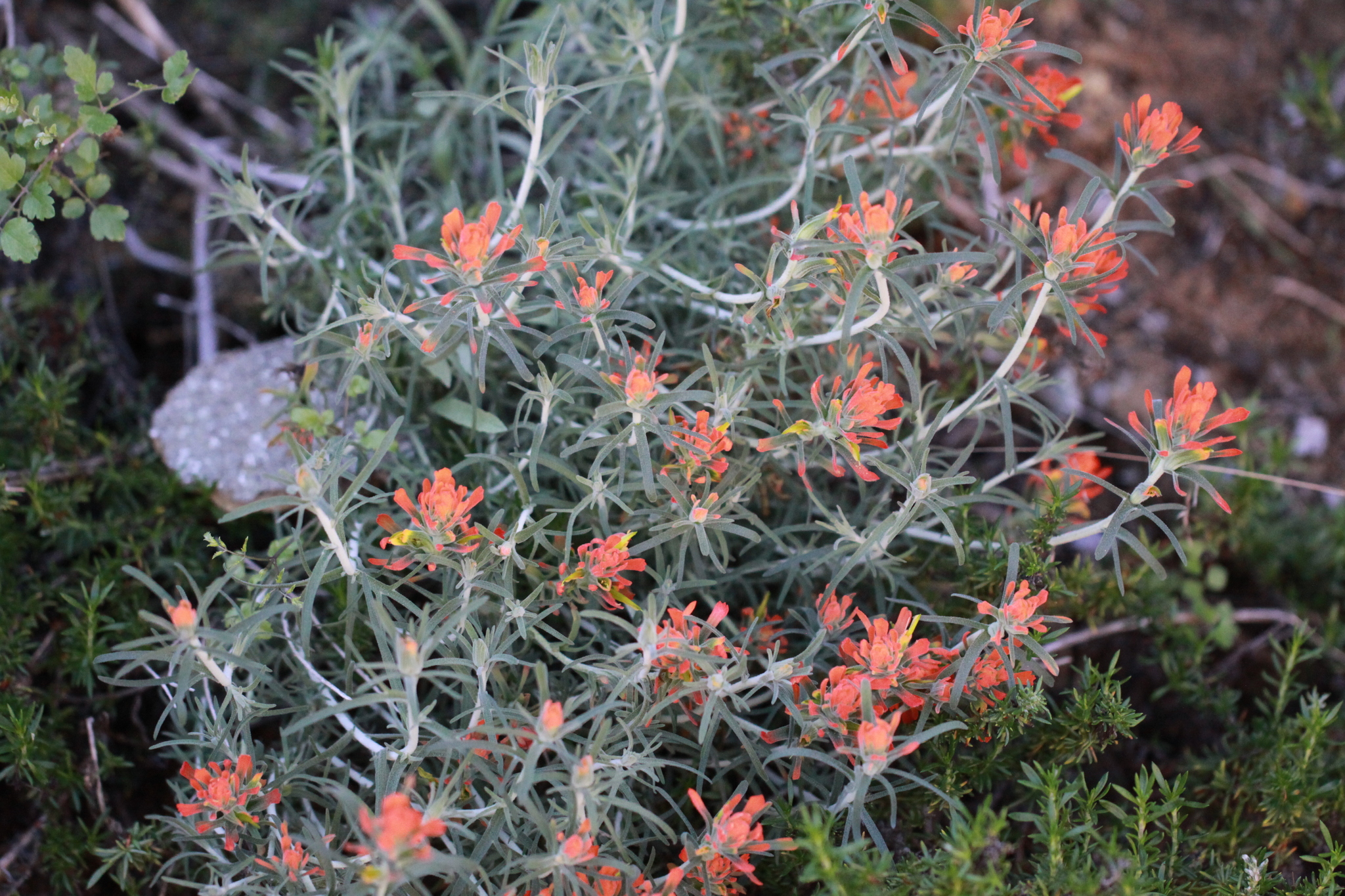
The image shows a plant with numerous small, bright orange flowers. The flowers are clustered at the tips of thin, green stems with narrow, elongated leaves. The plant appears to be growing in a natural setting, surrounded by other greenery and some dry twigs or branches. The overall appearance is bushy and vibrant due to the contrast between the orange flowers and the green foliage.
Wooly Indian Paintbrush (Castilleja foliolosa); NPS Photo/P. Simpson
The image shows a close-up of a person's hand gently holding a cluster of small, delicate flowers. The flowers have pale yellow petals with a hint of orange, and they are surrounded by slender, green leaves. The plant appears to be growing in a natural setting, with more similar flowers and foliage visible in the background. The person's hand is positioned to support the flowers, allowing for a clear view of their structure and color.
Wooly Indian Paintbrush (Castilleja foliolosa); NPS Photo/P. Simpson


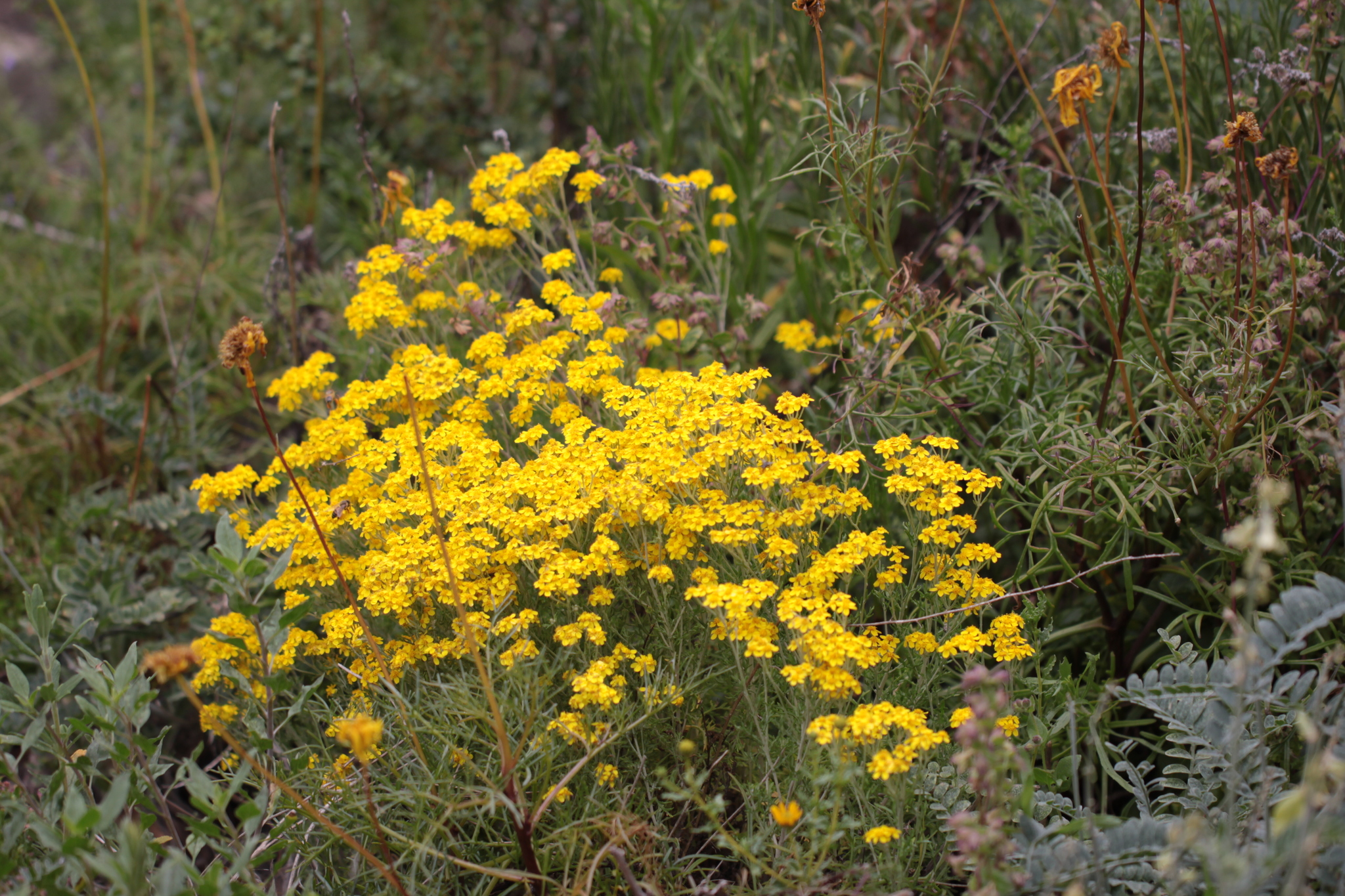
Golden Yarrow (Eriophyllum confertiflorum). Golden Yarrow is one of our most common plants in the park. Eriophyllum means “wooly leaved”. Both leaves and stems are hairy, but the stems are so much so, they have a light silvery-green appearance. Golden Yarrow is not a true Yarrow (genus Achillea), but the inflorescence shape is so similar to the Common Yarrow (Achillea millefolium) that it is named after it. However, Common Yarrow is white and does not occur in the park. Golden Yarrow is considered a small shrub that grows only to about 20 inches tall. When in bloom (Mar-Jun), it is sometimes mistaken for Clustered Tarweed. However the plants can easily be told apart by looking more closely at the flowers. Golden Yarrow disk flowers (the ones in the center of the head) are entirely yellow. Clustered Tarweed disk flowers have brown anthers.
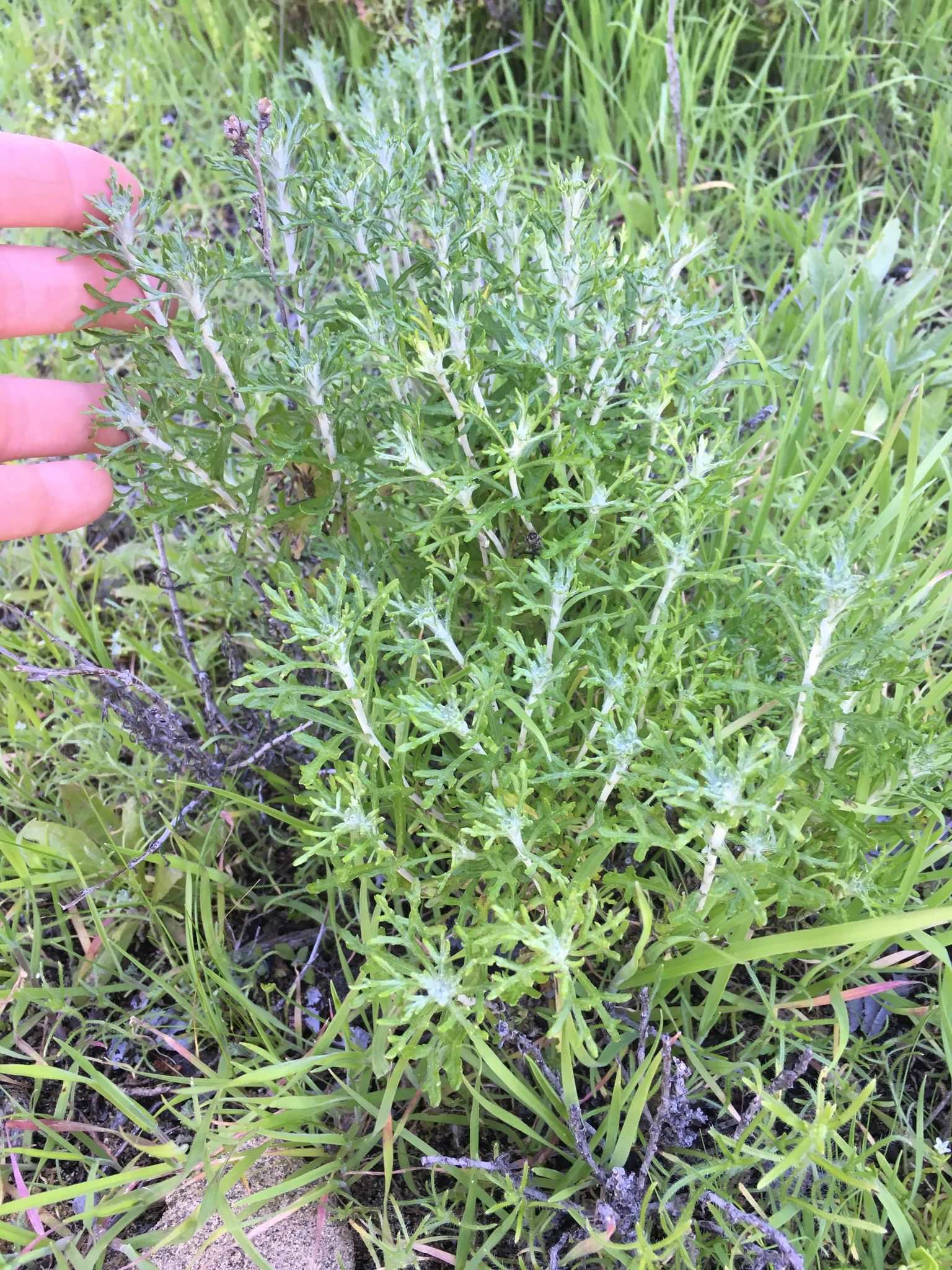
The image shows a close-up of a green plant with finely divided, feathery leaves. The plant is growing among other grass-like vegetation. A hand is gently touching or holding some of the plant's leaves on the left side of the image, providing a sense of scale. The surrounding area is filled with various shades of green, indicating a lush, grassy environment.
Golden Yarrow (Eriophyllum confertiflorum); NPS Photo/P. Simpson
The image shows a close-up of a cluster of small, bright yellow flowers. The flowers have multiple petals and are densely packed together, creating a vibrant display. The background is blurred, with hints of more yellow flowers, giving the image a soft and dreamy feel. The focus is primarily on the flowers in the foreground, highlighting their detailed texture and vivid color.
Golden Yarrow (Eriophyllum confertiflorum); NPS Photo/P. Simpson
The image shows a cluster of bright yellow flowers growing in a natural setting. The flowers are small and numerous, forming dense clusters on thin stems. They are surrounded by various types of green foliage and other plants, some of which have taller, slender stems. The background is filled with more greenery, giving the impression of a wild or untamed garden or meadow. The overall scene is vibrant and lively, dominated by the striking yellow of the flowers.
Golden Yarrow (Eriophyllum confertiflorum); NPS Photo/P. Simpson


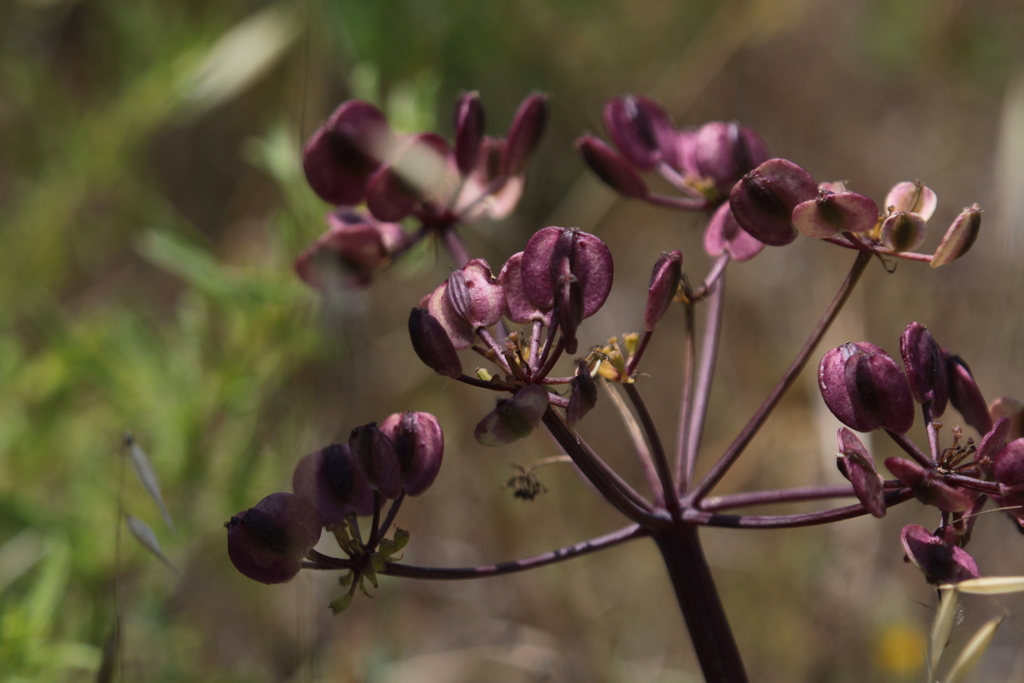
Shiny Biscuitroot (Lomatium lucidum). Plant in the carrot family, native to coastal mountains and canyons of southern California and Baja California. Blooms (Mar-Apr) are inflorescence of yellow flowers clustered in umbel (umbrella shaped). The leaves are large and shiny with several toothed lobes. The seed pods are often mistaken for flowers: they are flat red discs that remain on the plant for quite a while, before they brown and fall off.

The image shows a patch of green vegetation growing on a dry, earthy ground. The central plant has broad, jagged leaves and clusters of small, yellow-green flowers. Surrounding this plant are various other grasses and small plants, some with thin, long leaves. There are also a few small, red-orange flowers visible in the upper left corner of the image. The ground is covered with dry twigs and sparse patches of grass. The scene appears to be in a natural, possibly wild, setting.
Shiny Biscuitroot (Lomatium lucidum); NPS Photo/P. Simpson
The image shows a close-up of a plant with a cluster of small, dark purple, pod-like structures at the end of its stems. The plant's stems are slender and also have a purplish hue. The background is blurred, with hints of green and brown, suggesting a natural outdoor setting, possibly a field or garden. The focus is primarily on the plant, highlighting its unique structure and color.
Shiny Biscuitroot (Lomatium lucidum); NPS Photo/P. Simpson

Western Ponyfoot (Dichondra occidentalis). The Western Ponyfoot is a perennial ground cover that grows most vigorously between February and June. The leaves are round and bright green. The flowers are very small and seldom visible due to the leaves large size (quarter-size). Ponyfoot usually dies back in the hotter months of the year and re-emerges after first rains. There is a very similar species of Ponyfoot, almost identical in fact, that grows in a lot of ornamental gardens and unfortunately a few places at the park: The Asian Ponyfoot (Dichondra micrantha). They are very difficult to tell apart, but the best way is to look at the fruit.

The image shows a close-up view of a patch of small green plants growing on sandy soil. The plants have wavy-edged leaves that are a vibrant green color. The ground is covered with small pebbles and twigs, and the sunlight casts shadows, highlighting the texture of the leaves and the soil. The overall scene suggests a natural, possibly arid environment.
Western Ponyfoot (Dichondra occidentalis); NPS Photo/P. Simpson

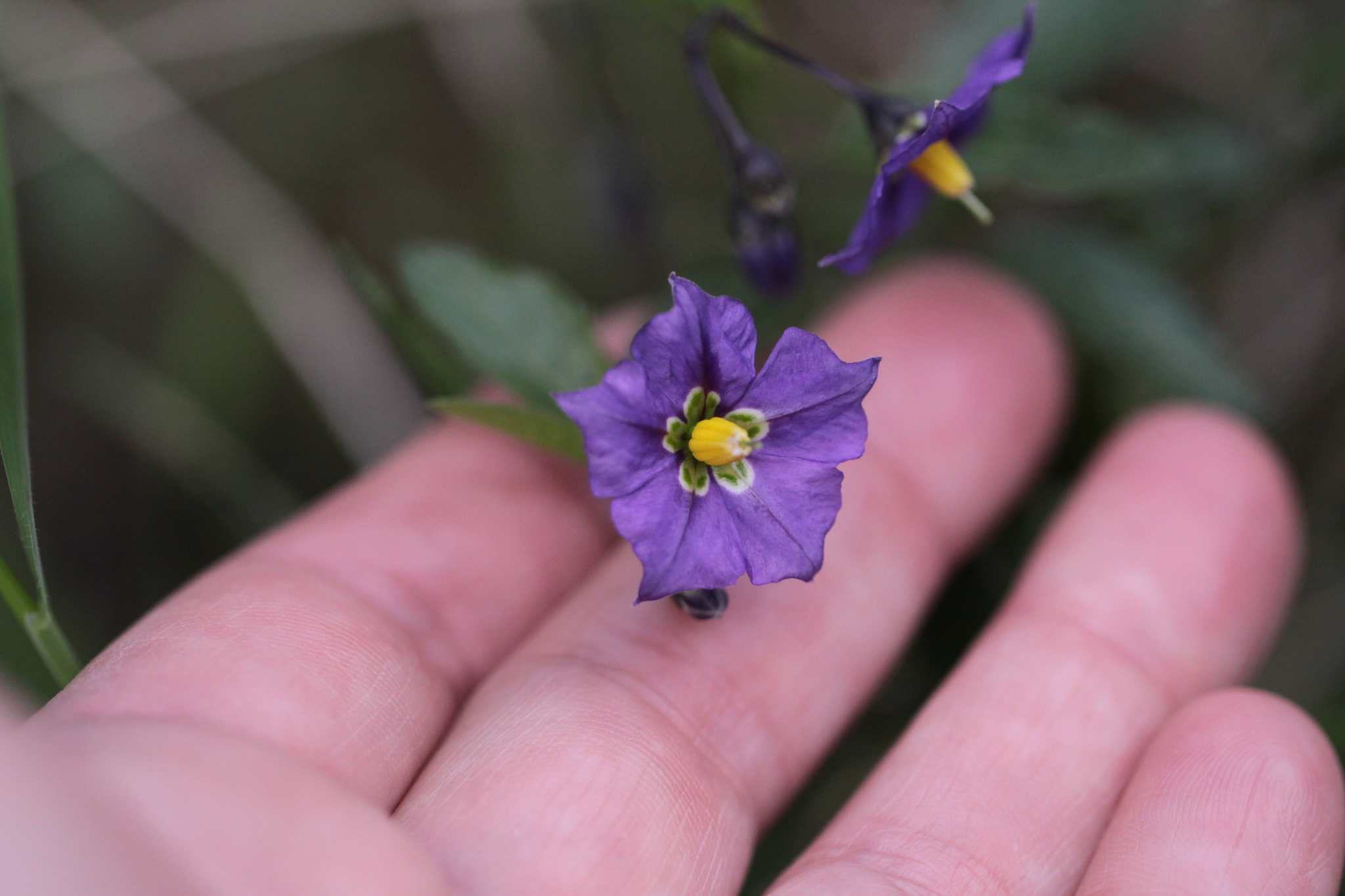
Parish’s Nightshade (Solanum parishii). The Parish’s Nightshade is a fairly common plant on the west coast, from Oregon to Baja California. It grows well in coastal, inland chaparral, woodland or forest environments. It’s bright purple flowers (Feb-Apr) are medium sized (about ¾ in. diameter). Pale to dark green dots with a soft white edge occur on the inside of the bloom and the long yellow anthers are prominent at the center of the flower. Leaves are oblong, mostly smooth edged, and come to a soft point. Stems are slightly ridged or ribbed. The fruit is a berry, green or black, a little over ¼ in. round.

The image shows a cluster of plants with green leaves and purple flowers. The flowers have a vibrant purple color with bright yellow centers. The leaves are elongated and have a slightly serrated edge. The plants are growing closely together, creating a dense and lush appearance. The background is filled with more green foliage, giving the scene a natural and wild look.
Parish’s Nightshade (Solanum parishii); NPS Photo/P. Simpson
The image shows a close-up of a small purple flower being gently held by a person's fingers. The flower has five petals and a bright yellow center. The background is blurred, with hints of green leaves and stems, suggesting the flower is part of a plant in a natural setting. The focus is primarily on the flower and the fingers holding it.
Parish’s Nightshade (Solanum parishii); NPS Photo/P. Simpson


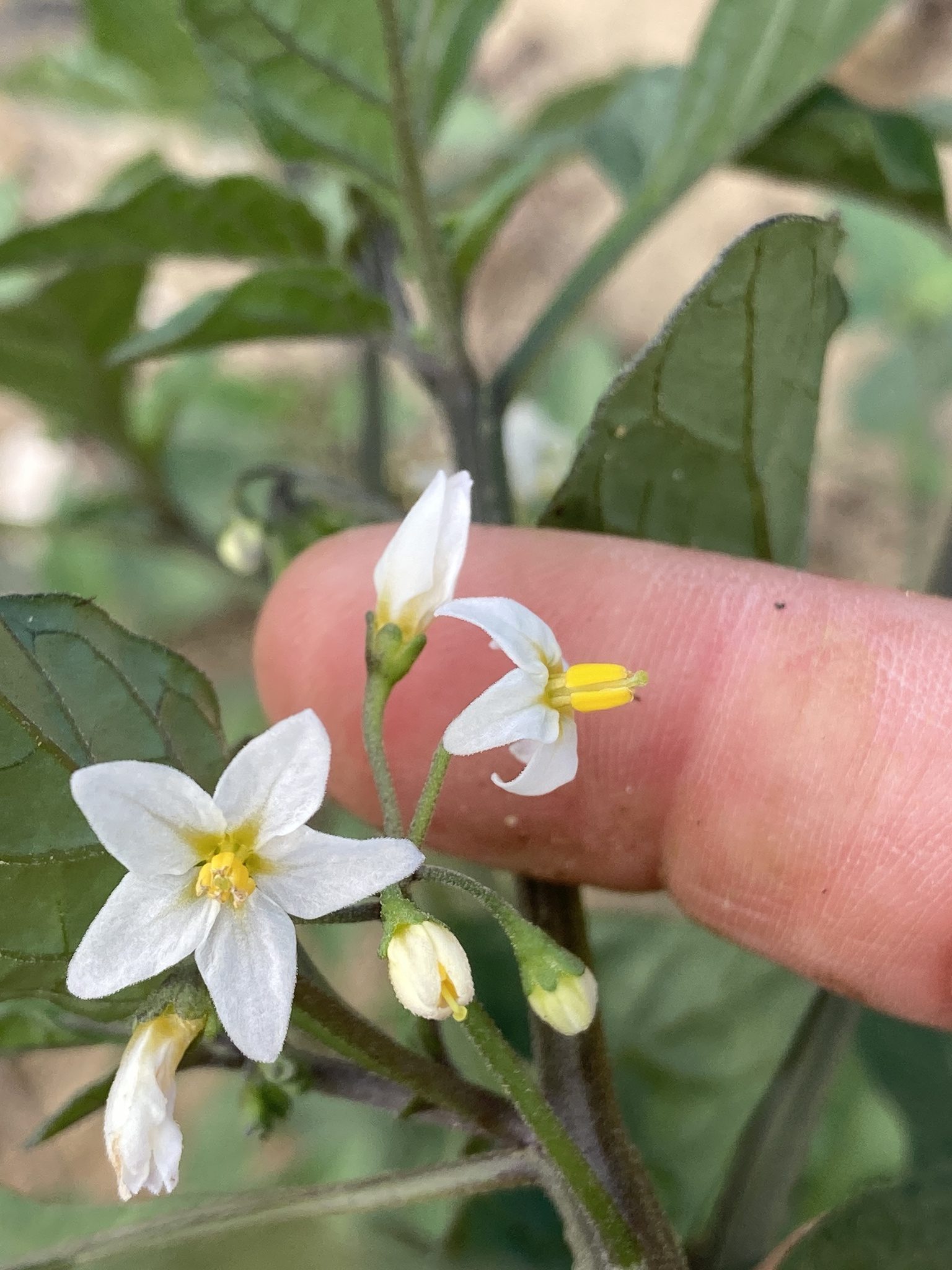
American Nightshade (Solanum americanum). We have two species of white flowering nightshades at the park. The American Nightshade is native, while the Black Nightshade (Solanum nigrum) is not. They look extremely similar and it is often difficult to tell them apart. American Nightshade is usually more densely leaved with smaller leaves and smaller flowers than Black Nightshade. However, the best way to tell them apart is with the length of the yellow anthers at the center of the flower: smaller for American Nightshade and about twice as long for the Black Nightshade (see photos below). Also, American nightshade sometimes has light purple flowers. That’s in contrast with Black Nightshade that have white petals. The fruits of American Nightshade are 1/8 to ¼ in. round, green or black and grow in clusters. The plant is a small bush that usually grows close to the ground and can spread over several feet. The blooming period of the American Nightshade is very variable depending on weather conditions, though flowers are most often seen in spring and summer.

The image shows a patch of green plants growing on a sandy and slightly rocky ground. The plants have small, oval-shaped leaves and appear to be low-growing, spreading across the ground. There are a few tiny purple flowers scattered among the leaves. The surrounding area is mostly bare soil with some small rocks and pieces of dried wood or bark.
American Nightshade (Solanum americanum); NPS Photo/P. Simpson
The image shows a close-up of a plant with small, shiny black berries. The plant has green leaves with slightly serrated edges. A person's fingers are gently holding a cluster of three black berries. In the background, there are more green berries and a small white flower with a yellow center. The overall setting appears to be outdoors, with a natural, green backdrop.
American Nightshade (Solanum americanum); NPS Photo/P. Simpson
The image shows a close-up of a person's hand holding a small plant with delicate flowers. The flowers are small and star-shaped, with five petals each. They are light purple with a yellow center. The plant has green leaves that are slightly elongated and pointed. The background is blurred, showing more greenery and some brown patches, possibly soil.
American Nightshade (Solanum americanum); NPS Photo/P. Simpson

Black Nightshade

The image shows a close-up of a small plant with delicate white flowers. The flowers have five petals each and a yellow center. Some of the flowers are fully open, while others are still in bud form. A person's finger is gently holding one of the stems, providing a sense of scale and showing that the flowers are quite small. The leaves of the plant are green and have a slightly fuzzy texture. The background is blurred, focusing the attention on the flowers and the finger.
Black Nightshade; NPS Photo/P. Simpson

American Nightshade

The image shows a close-up of a small plant with delicate white flowers. The flowers have five petals each and bright yellow stamens in the center. The plant has green leaves with a slightly rough texture. A person's finger is visible in the background, providing a sense of scale, indicating that the flowers are quite small. The background is blurred, focusing attention on the flowers and leaves.
Am. Nightshade; NPS Photo/P. Simpson


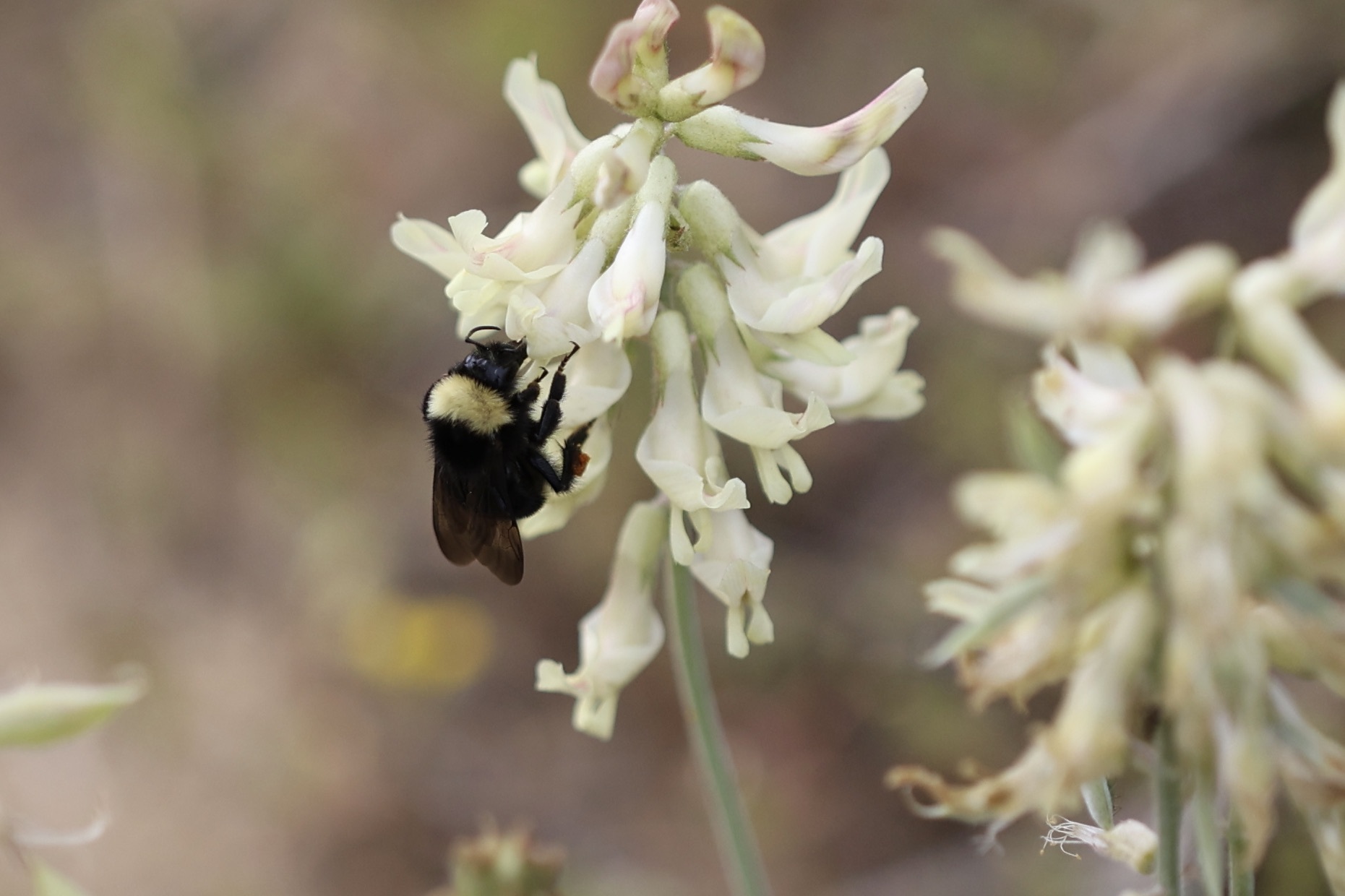
Locoweed (Astragalus trichopodus). This plant is known by many names: Santa Barabara Milkvetch, Rattlepod or Rattleweed, Ocean Locoweed, to names a few. Most Astragalus species are toxic so the plant is often removed from ranches so the cattle doesn’t eat it and become “loco” (crazy). But little is known about the actual toxicity of our particular species. The Locoweed is often mistaken for bladderpod because of its seed pods. They are a similar shape (bladder-like) and color (light green), but the two plants are very different. Bladderpod is a relative of Mustards, while Locoweed is a Legume. The Locoweed flowers are white to pale yellow (Bladderpod flowers are bright yellow) and is a small herbaceous plant growing close to the ground (Bladderpod is a medium upright shrub). Locoweed is a perennial and even though it dies back to the ground in the hot season, it re-sprouts after first rains. It is an early bloomer, sometimes showing it’s colors as soon as January, and is a favorite of Bumble Bees. It is very drought resistant and resilient. I have a patch of dirt at my house, where nothing grew. The Locoweed thrives there.

The image shows a patch of small, delicate plants with thin, wiry stems and clusters of tiny, pale yellow flowers. The plants have a silvery-green appearance due to their fine, feathery leaves. They are growing in a garden bed bordered by red bricks. The ground around the plants is covered with small pebbles, and there are a few green leaves from other plants visible in the background. The overall setting appears to be a garden or landscaped area.
Locoweed (Astragalus trichopodus); NPS Photo/P. Simpson

California Bumble Bee (left) and Yellow-faced Bumble Bee (right) are two of the five species we have in San Diego County. All five species occur in the park. The Yellow-faced Bumble Bee is the most common. It is easily recognizable from the other due to its yellow face and lack of yellow hair on the abdomen, except for a band near the end. The California Bumble Bee exhibits the same characteristics, but has no hair on the face.
VINES
Southern California Clematis (Clematis pauciflora). Clematis is a woody vine that climbs on many other plants, but doesn’t smother or parasitize them. It has dark green lobed leaves and small pale yellow flowers (Feb-Apr). After the blooms come the seeds. The seed clusters look like little balls of fur on the plant and these spark the curiosity of many visitors. The vine is deciduous and tends to disappear in the background of the chaparral during the hottest months.

The image shows a close-up of a plant with clusters of small, creamy white flowers. The flowers have long, thin petals that give them a spiky appearance. The plant has green leaves with a slightly serrated edge, and the background is filled with more green foliage, suggesting a lush, natural setting. The lighting is bright, indicating that the photo was likely taken during the day.
Southern California Clematis (Clematis pauciflora); NPS Photo/P. Simpson
The image shows a close-up of fluffy, white seed heads of a plant, likely a type of clematis. The seed heads have a feathery appearance with long, delicate strands radiating from a central point, which is a dark reddish-brown color. The background consists of green leaves and brown branches, suggesting the plant is growing in a natural, outdoor setting. The lighting is bright, indicating it is a sunny day.
Southern California Clematis (Clematis pauciflora); NPS Photo/P. Simpson


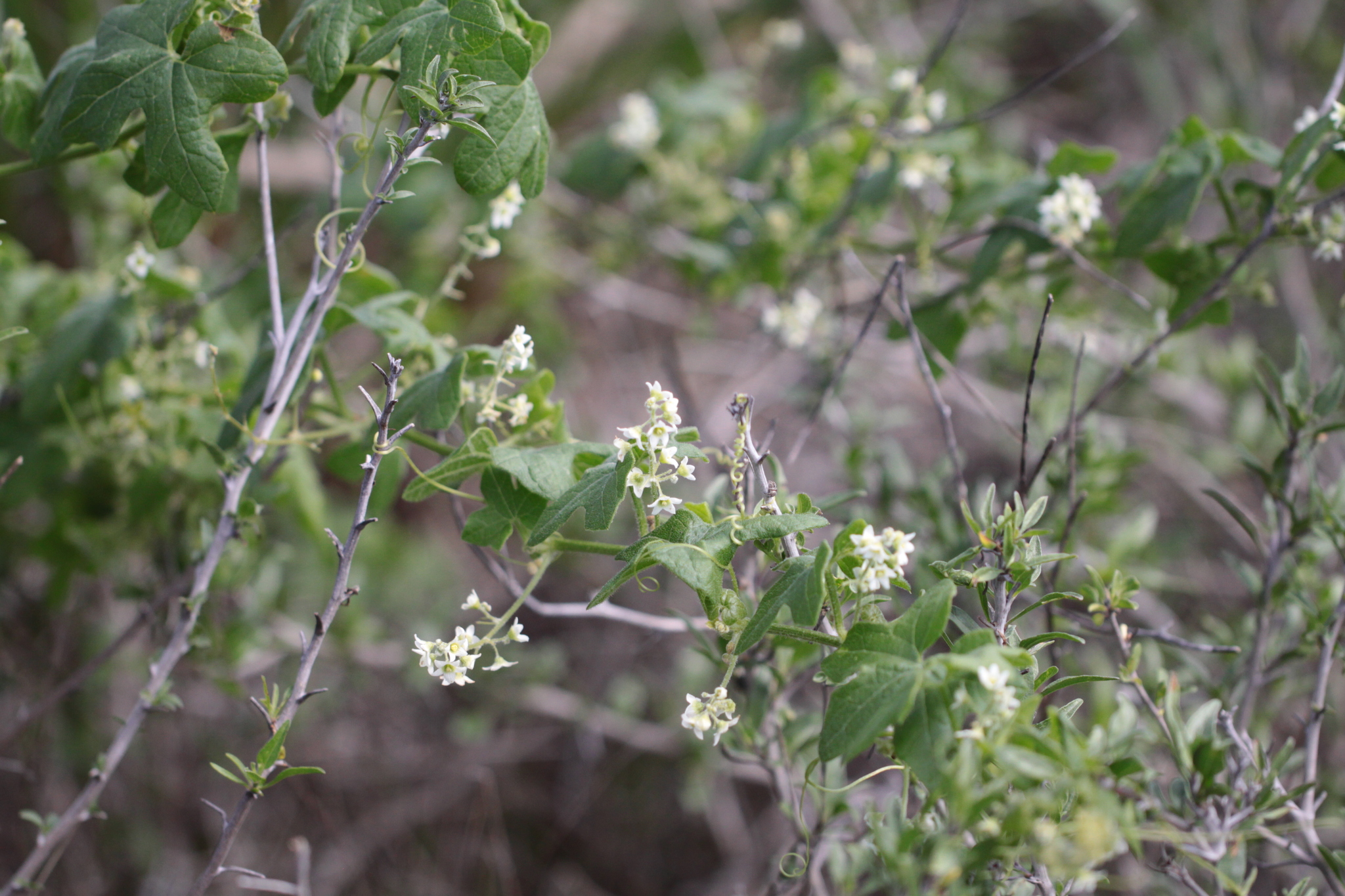
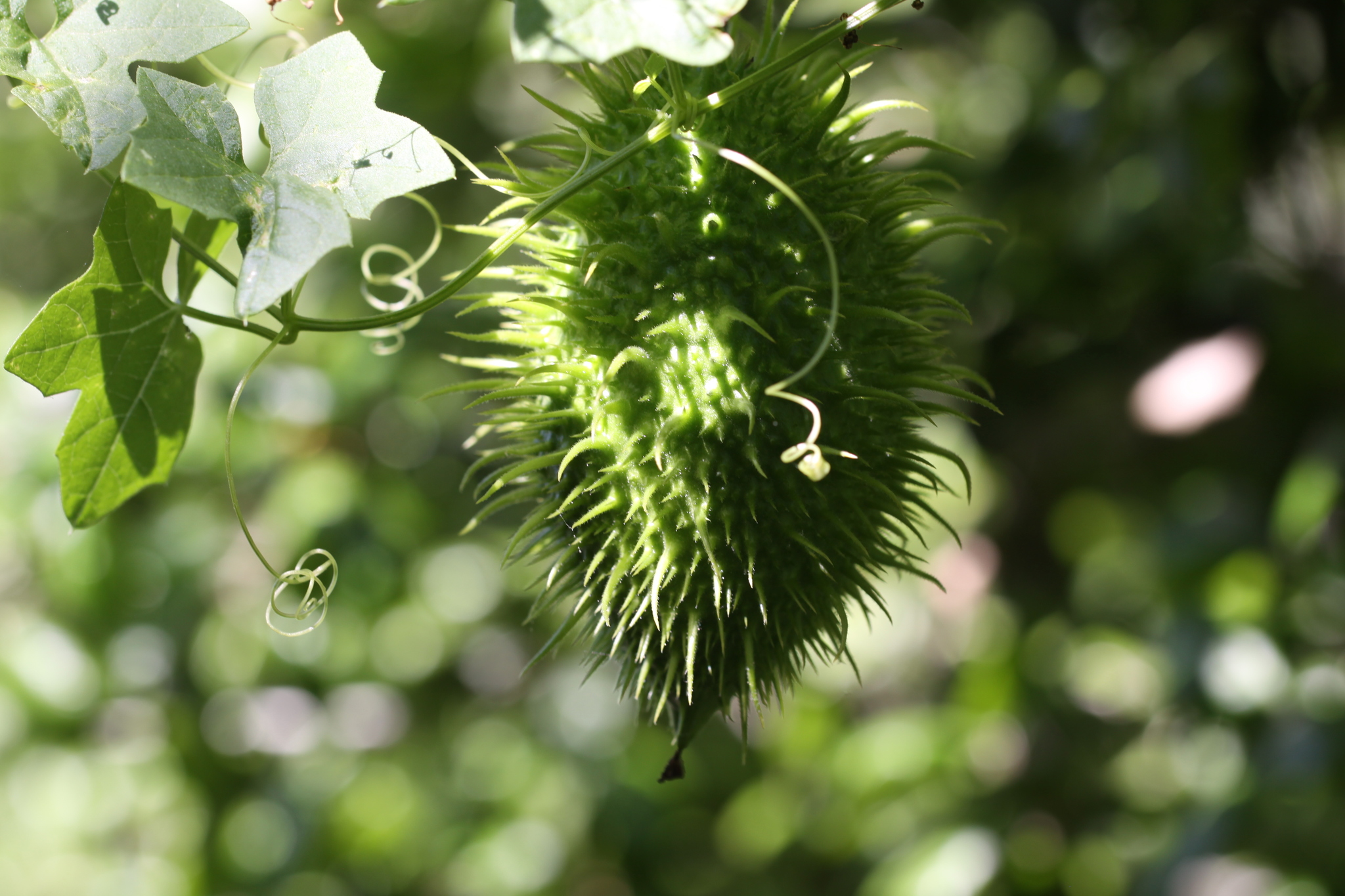
Wild Cucumber (Marah macrocarpa). Wild Cucumber is a vine. It is not parasitic and only uses other plants for support using tendrils that wraps around sturdier vegetation. It doesn’t affect the health of the plant it climbs on except for temporarily depriving it of some sunlight. Wild Cucumber has two remarkable features. #1: its fruit! Yes, it is a cucumber, but it looks nothing like the fleshy vegetable found in our grocery stores. In fact, there’s nothing for us to eat. The fruit is hollow and houses M&M-sized seeds. The fruit certainly attracts the attention of visitors. It is fist-sized, green, and very spiky! While there is nothing for us to eat on a Wild Cucumber fruit, the seeds provide an excellent food source for many local rodents. Some of them will cache (hide) seeds under litter. Forgotten cache may germinate and become new plants! #2: the root. Another name for Wild Cucumber is Man-root. Why? The root can grow to a remarkable size. When the seed germinates, it sent a tuber downward and a shoot up. That tubber grows very quickly and is said to grow to the size of a man under ground. I have never seen one quite that big, but it certainly grows to the size of a boulder. A few roots are visible toward the bottom of the Oceanside Trail, before reaching Cabrillo Rd. Another larger root is visible on the hill side opposite to the Bayside Trail entrance (see photos to right).

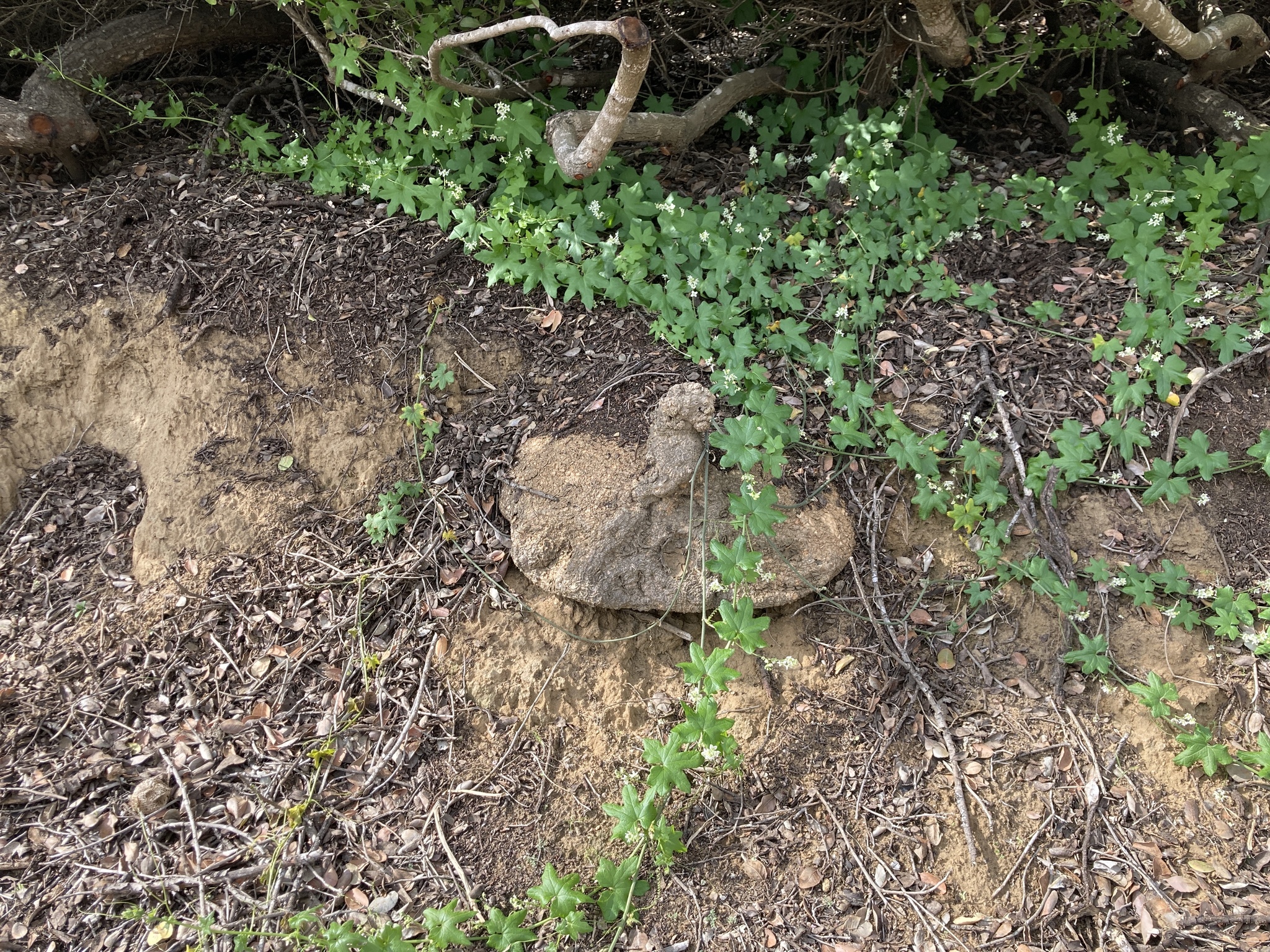
The image shows a section of a hillside with dense green shrubs or small trees growing on top. The branches of the shrubs extend outward, and some appear to have been cut, as indicated by the fresh, lighter-colored cuts on the branches. The ground is a mix of soil and dried leaves, with a noticeable erosion or cut in the earth, revealing a vertical section of soil. In the middle of this section, there is a large, irregularly shaped piece of earth or rock that protrudes from the hillside, resembling a natural formation. The overall scene suggests a natural, possibly wild area with some human intervention in the form of branch cutting.
Wild Cucumber (Marah macrocarpa); NPS Photo/P. Simpson
The image shows a section of ground with a mix of soil, rocks, and vegetation. There is a prominent rock in the center, partially embedded in the soil. Surrounding the rock, there are green plants with lobed leaves, some of which have small white flowers. The soil appears dry and is covered with a layer of dried leaves and twigs. In the background, there are branches and more dense foliage. The scene suggests a natural, possibly forested or bushy area.
Wild Cucumber (Marah macrocarpa); NPS Photo/P. Simpson
The image shows a close-up of a plant with green leaves and small white flowers. The leaves are broad and have a slightly wrinkled texture. The flowers are clustered in small groups along the stems, and they have a delicate appearance. The background is a bit blurred, but it seems to be a natural setting with more greenery. The plant appears to be growing among some thin, woody branches.
Wild Cucumber (Marah macrocarpa); NPS Photo/P. Simpson
The image shows a close-up of a green, spiky fruit hanging from a vine. The fruit is oval-shaped and covered with numerous soft spikes. Surrounding the fruit are green leaves and tendrils of the vine, which are curling and twisting around. The background is blurred, with various shades of green, suggesting a lush, leafy environment. The lighting is bright, highlighting the texture of the fruit and leaves.
Wild Cucumber (Marah macrocarpa); NPS Photo/P. Simpson

SUCCULENTS
Ladyfingers (Dudleya edulis). Also called Fingertips, Ladyfingers is one of three Dudelya species we have in the park. Lanceleaf Dudleya (Dudleya lanceolata) and Chalk Dudleya (Dudleya pulverulenta) are the other two. Ladyfingers are abundant on the Oceanside trail. Since they are succulents, they are very resilient and drought tolerant. A large number of them were removed from the trail path before construction of the trail. They were kept at the Cabrillo greenhouse until construction was complete and replanted around the trail just before the grand opening. Ladyfingers are easy to identify: long thick finger-like leaves that spread up from a central root and the flowers are white (Apr-Jun). According to the book Kumeyaay Ethnobotany by Michael Wilken-Roberston, “people chewed the tender leaves to alleviate thirst. The inflorescences, when first coming up, are sweet, juicy and edible.”
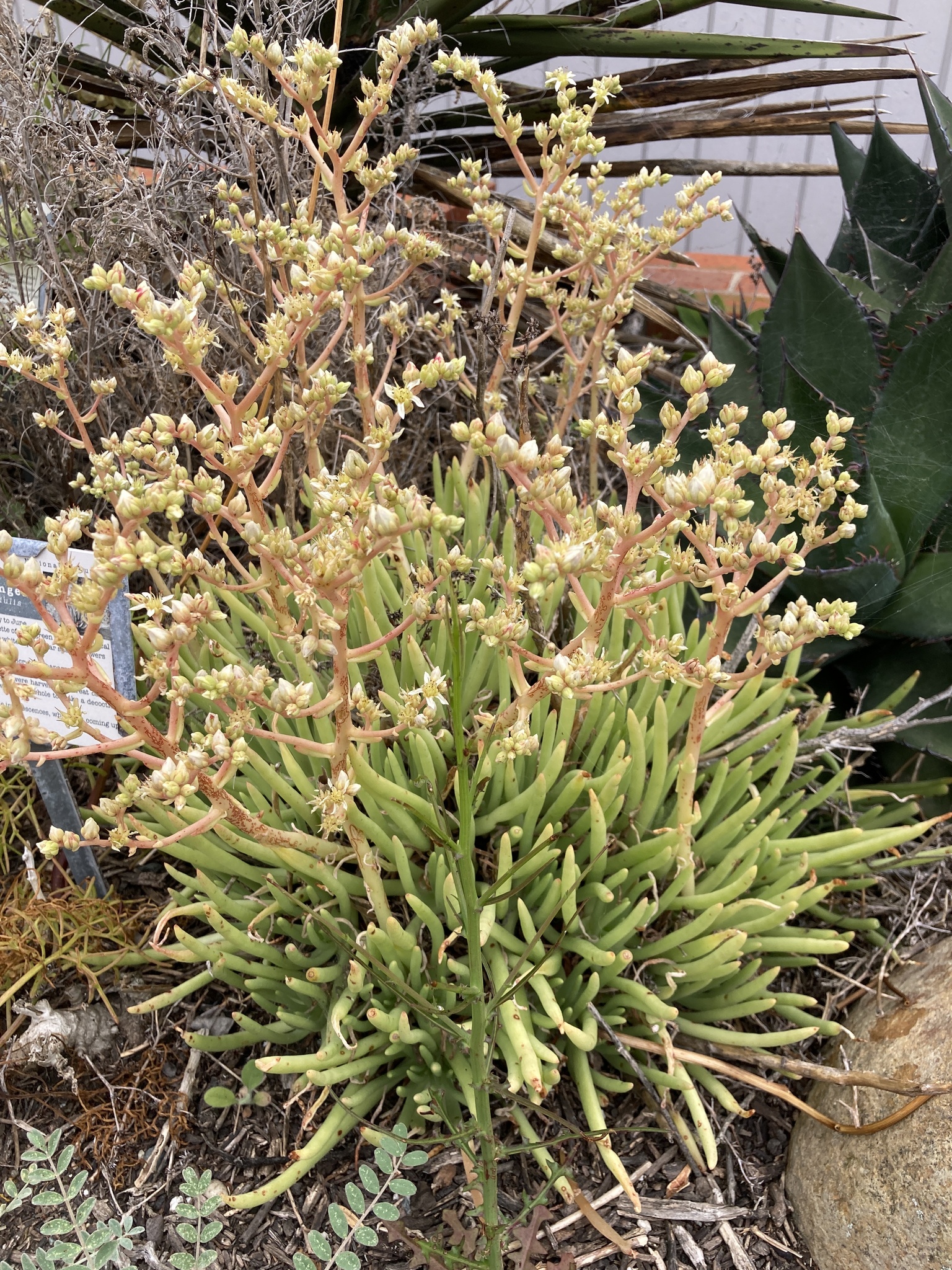
The image shows a succulent plant with long, slender, green leaves that grow upwards and outwards from the base. Above the leaves, there are numerous branching stems with small clusters of pale yellow or cream-colored flowers. The stems are a light brownish color. In the background, there are other plants, including some with large, dark green, spiky leaves. There is also a small sign or label partially visible on the left side of the image, but the text on it is not clear. The plant is growing in a garden setting with soil and mulch visible at the base.
Ladyfingers (Dudleya edulis); NPS Photo/P. Simpson


Chalk Dudleya (Dudleya pulverulenta). The Chalk Dudleya is among the most popular native succulents in urban gardens, though they are still underused in comparison to exotic species. The tubular flowers sit on top of red-leafed tall stalks and are a favorite of hummingbirds, who will keep guard and chase any intruder. Flowers also attract many bee species, big and small. The smallest bees will enter the bloom and fit their entire body into it to get to the nectar. Just like the Ladyfingers, Chalk Dudleya plants were salvaged from the trail before and during construction and were planted back after the trail’s opening. On the Oceanside Trail, Chalk Dudleyas are most abundant toward the bottom of the hill and into the coastal area.

The image shows a succulent plant growing in a dry, arid environment. The plant has a rosette of fleshy, pale green leaves at its base, with a hint of pink on the edges. From the center of the rosette, several tall, slender stalks rise upwards, each adorned with small, pink, bell-shaped flowers. The surrounding area is filled with dry twigs and branches, indicating a desert or semi-desert setting. There is also some greenery visible in the background, suggesting sparse vegetation in the area.
Chalk Dudleya (Dudleya pulverulenta); NPS Photo/P. Simpson
The image shows a small, succulent plant growing in a dry, cracked soil area. The plant has thick, fleshy leaves arranged in a rosette pattern, with several tall, spiky stems extending upwards. The leaves are a mix of green and pinkish hues, and the stems have a similar coloration. Surrounding the plant, there are patches of green vegetation and some small rocks scattered on the ground. The scene is sunlit, casting shadows on the ground and highlighting the textures of the soil and plant.
Chalk Dudleya (Dudleya pulverulenta); NPS Photo/P. Simpson
The image shows a close-up of a plant with reddish-pink stems and small, tightly clustered leaves or buds. The plant stands out against a background of dry, tangled branches or twigs that are grayish in color. The contrast between the vibrant plant in the foreground and the muted, dry background creates a striking visual effect. There are also some small patches of green and brown vegetation visible around the edges of the image.
Chalk Dudleya (Dudleya pulverulenta); NPS Photo/P. Simpson

revised 22-Oct-24