

By Karissa Duran, Scripps Institute of Oceanography
May 19, 2023
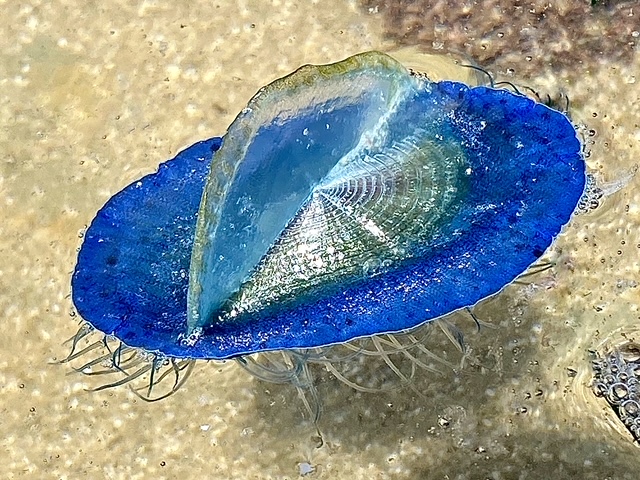
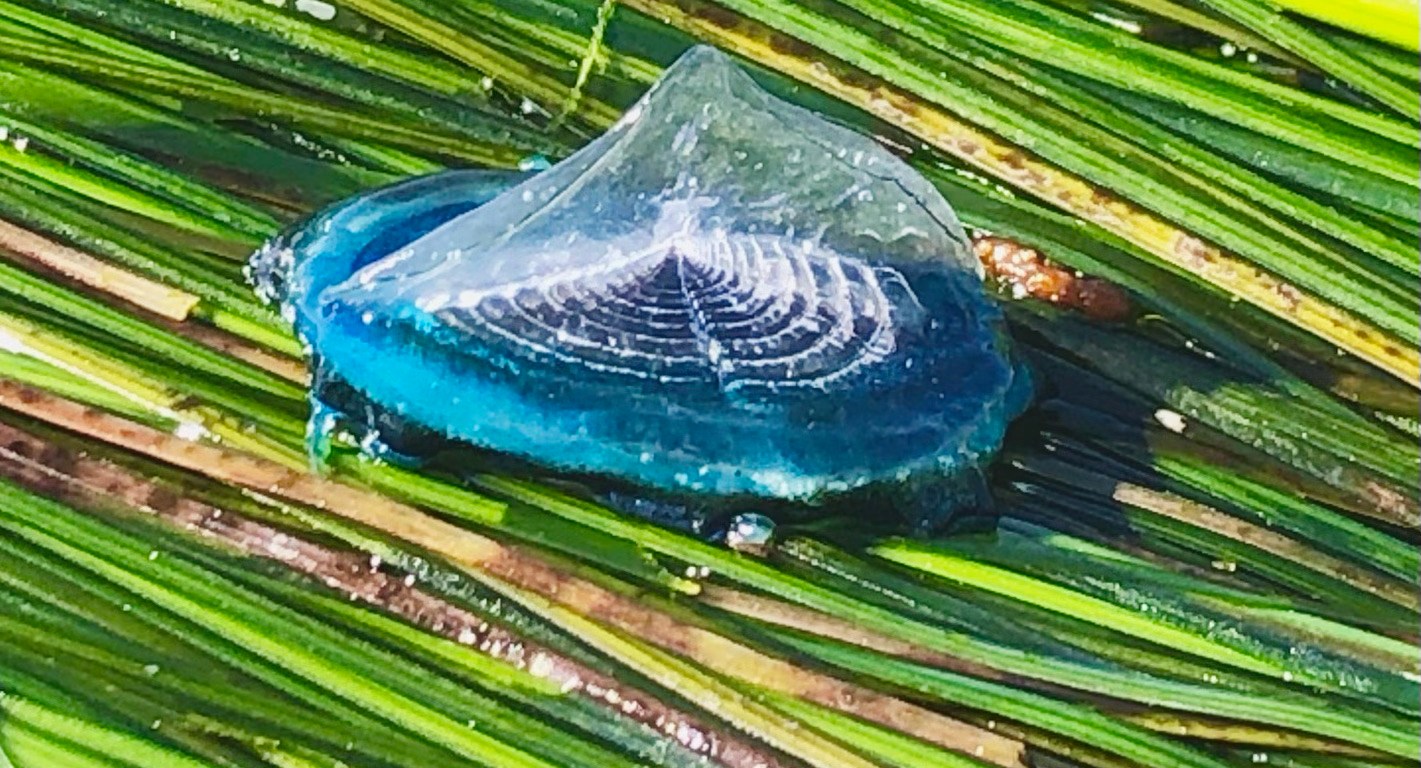
What are these blue jellyfish-like creatures?
These creatures are called Velella velella. They have several different nicknames including “by-the-wind-sailors” and “little sails” as a reference to their sail-like, chitinous structure that sticks up above the water.
Why are they washing up?
They wash up on shore due to a combination of shoreward wind and current patterns. Velellas float on the surface of the ocean, have no means of locomotion, and are moved across the water by ocean currents and the wind that catches their “sails.”

Where can I find them?
While Velella velella are a species that are typical in warm and temperate waters, it is not easy to predict when and where you can find them. Your best bet at finding them on the beach is during times of increased shore-ward flow. However, keep your eyes out for them if you are boating, surfing, or paddling as you may get lucky to see some on the water, too!
Are they jellies?
The term jellies usually refers to animals within the group Scyphozoa that have a very characteristic umbrella shaped medusa stage, like moon jellies, or our purple striped jelly. However, Velella velella and these true jellies belong in the same higher level group Cnidaria, but Velella vellela are part of a group called Hydrozoa and are more closely related to the Portuguese man o’war. Velella velella are actually a group of individuals or a colony with specific functions put together to make one functional organism.
Are they harmful / do they sting?
Velellas do possess stinging cells and a neurotoxin to stun their small zooplankton prey; however, usually are not strong enough to penetrate or harm human skin. These stinging cells are located in their tentacles, but not the sail. Because we do have other types of stronger stinging jellies that are blue-purple in color that could be challenging for a beachcomber to identify, we usually advise to observe, take photos, but refrain from disturbing them. Velellas are benign to humans. Velellas are a part of a phylum called cnidarian, thus – like jellies – they do have specialized stinging cells at the end of their tentacles called “nematocysts.” However, the stinging cells on velellas are optimized to catch their prey, which are mostly invertebrate zooplankton.
What do they eat?
Velella velella mostly eat invertebrate zooplankton (small swimming crustaceans like copepods) and the occasional larval fish depending on the size of the Velella and how much food is in the water.
What does the life cycle of these creatures look like?
The life cycle has been suggested to begin in the deep ocean. The 1-2 millimeter sexually reproducing medusa stage releases eggs that are fertilized and develop into a larva. This larva develops a rudimentary float and a structure that secretes oil to make it positively buoyant. These creatures continue to grow, the float enlarges, tentacles and sails appear that allow them to head to the surface and begin to feast on tiny crustaceans they stun into submission with stinging cells and a neurotoxin. This ascent to the surface usually happens in the spring when conditions support a lot of zooplankton food. Then the well-developed sailors release new medusae that descend to the deep to begin the life cycle again.
What happens to them when they wash ashore?
The Velella velella that continue to wash ashore in Southern California will either be pulled back into the ocean by the tide or break down naturally, where they may serve as food for other scavenging critters.
How long can people expect to see them on the beach?
They are most likely to be blown onto beaches during late spring and early autumn due both to local wind, current, and tidal patterns, but this doesn’t happen every year. They are difficult to predict, so keep an eye out for them if you’ve heard reports they are in your coastal area.
For more information:
YouTube Videos
 CNM VIP Voice